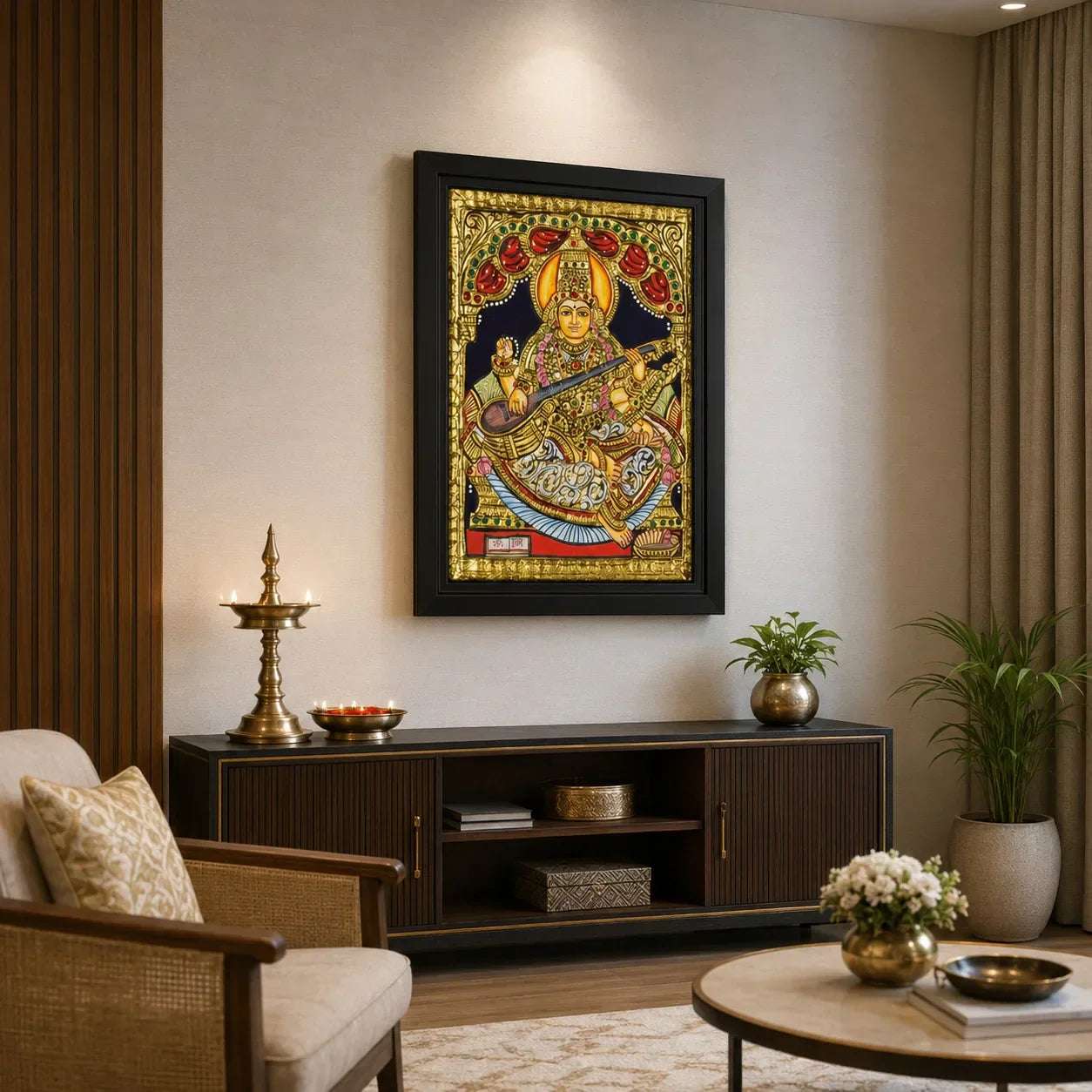
For a high-net-worth art collector, investing in traditional Indian heritage is a powerful statement of taste. However, the premium art market is heavily flooded with cheap, factory-made digital posters masquerading as authentic tribal masterpieces. If you are browsing online to find how to spot a genuine piece or looking for a distinct pichwai tanjore painting, this structural guide will shield your capital.
Whether you are collecting a rare bhil art peacock painting or verifying a sacred durga slaying mahishasura layout, here is how to isolate the uncopyable human trace from a flat fake [source: 1, 5].
Part 1: The Core Technical Masterclass: How to Identify Original Tanjore Painting
Serious art collectors constantly drop a critical query into search engines: how to identify original tanjore painting. Authentic Thanjavur art is a centuries-old sacred process that cannot be simulated on commercial digital plotters.
1. The 22-Karat Real Gold Leaf Test
An authentic Tanjore painting uses pure 22-karat gold foil chemically bound to a wooden plank over a chalk-and-tamarind-paste relief. Real gold leaf retains its brilliant, warm metallic luster for centuries without fading. If a painting uses cheap chemical gold foil or metallic paint, it will develop dark spots and turn completely black within two to three years due to oxidation.
2. The Gesso Relief and Gemstone Settings
Run your fingers gently over the canvas. True Tanjore art features a distinct, hand-embossed 3D gesso relief work. Authentic semi-precious Jaipur gemstones are deeply embedded within this relief, never loosely glued on the surface. If you see flat digital inks or perfectly symmetrical plastic beads, you are looking at a commercial fake. To acquire verified lineage pieces, explore our official certified collection:
Avyaan Tanjore Paintings Catalogue.
Part 2: Tribal Physics: Spotting an Authentic Bhil Art Peacock
Moving from the royal courts to Central India, tribal art is facing a massive cloning crisis. Your search data highlights an expanding interest in a bhil art peacock or general bhil art aesthetics.
The Dot Architecture Secret (Zero Stencils)
Traditional Bhil painting is a cosmic visual language executed entirely through freehand multi-colored Pithora micro-dots. A true tribal master artisan never uses modern stencils, pencils, or alignment software. Each micro-dot represents a specific prayers or family lineage, forming organic, slightly uneven rhythms.
If you analyze a piece and find that the dots are perfectly round, geometrically uniform, or printed via synthetic ink rollers, it is a mass-produced industrial replica. Genuine tribal pieces are painted using local earth materials like Ramraj yellow clay, Geru red earth, and castor lamp soot. Secure an untampered, original masterpiece directly from our registry:
Avyaan Bhil Art Paintings Collection.
Part 3: Sacred Narrative Forms: Pattachitra & Pichwai
Traditional canvas formats like Odisha Pattachitra and Rajasthani Pichwai carry strict material laws that separate them from flat digital prints.
1. Pattachitra Structural Science
When reviewing an intricate durga slaying mahishasura narrative or exploring goddess durga slaying mahishasura themes in Pattachitra, the canvas backing is the ultimate evidence. Genuine Pattachitra is painted on an organic cotton cloth hand-burnished with crushed tamarind seeds and chalk powder. The white pigment is strictly derived from "Sankha Potta" (marine conch shell white) and bound with natural Acacia tree resin. Micro-fine outlines are executed using a brush as thin as a single hair.
2. Pichwai Styling Dynamics
Modern homes are heavily introducing traditional elements via
pichwai plates and wall panels [source: 3]. Authentic Pichwai on fabric requires a canvas boiled with wheat flour paste (Maand) and painted using pure mineral stones like Lapis Lazuli and Malachite. If the artwork smells like synthetic acrylic paint or feels chemically smooth, it has zero antique value. Explore our heritage configurations:
Avyaan Pichwai Plates Selection.
Part 4: ऑरिजनल पेंटिंग गाइड: How to Spot a Fake Before You Pay (Hindi)
अगर आप अपने लिविंग रूम के लिए एक प्रीमियम और ऑथेंटिक पेंटिंग ढूंढ रहे हैं, तो आपको how to identify original tanjore painting और pichwai tanjore painting की बुनियादी मटीरियल केमिस्ट्री पता होनी चाहिए
एक असली तंजौर पेंटिंग हमेशा लकड़ी के बोर्ड (Wood plank) पर ऑर्गेनिक सूती कपड़े को चिपकाकर बनाई जाती है. इस पर की गई नक्काशी (Relief work) में शुद्ध २२-कैरेट सोने के वर्क (Real Gold Leaf) का इस्तेमाल होता है. इसके विपरीत, बाजार में मिलने वाली कॉपियां केवल पेपर या सिंथेटिक बोर्ड पर की गई साधारण इंकजेट प्रिंटिंग होती हैं, जिनमें सोने की जगह पीला रंग या केमिकल फॉयल लगा होता है.
धोखाधड़ी से बचने के लिए केवल वही कलाकृतियां खरीदें जिनके साथ Official Studio Lineage Registry Certificate शामिल हो.
Q1: Why do original Tanjore paintings demand a high price premium in the art market?
Authentic Tanjore paintings are permanent, generation-transcending structural assets rather than temporary decor. Each single piece requires up to three months of rigorous manual labor by traditional lineage artisans. The extensive integration of pure 22-karat real gold leaf and authentic semi-precious gemstones ensures that the painting never loses its radiant metallic value, acting as a tangible material heirloom.
Q2: How can a collector differentiate between an organic Bhil painting and a digital replica?
An organic Bhil art masterpiece displays a beautiful, uncopyable human trace. The hundreds of multi-colored dots are drawn entirely freehand using fine organic pigments like Geru (red earth) and Castor soot, creating subtle, uneven variations in thickness and paint density. Digital replicas exhibit sterile, perfectly circular CMYK dots with uniform laser symmetry and zero raw texture.
Q3: What is the significance of the Durga Slaying Mahishasura artwork in traditional Pattachitra?
The narrative of goddess durga slaying mahishasura or durga slaying mahishasura in Pattachitra represents the ultimate balance of cosmic energy. Executed with micro-fine brushes using natural marine conch shell white and cinnabar stone red, it captures the intense physical motion and traditional authority of the deity with flawless geometric discipline.
The Verdict: Secure an Authenticated Heritage
As an elite art collector, your deep risk is unknowingly buying mass-market clones from deceptive mid-tier interior shops. True art requires strict lineage tracing and certified verification. Secure your architectural space with genuine, uncopyable visual history. View our official catalog assets and explore original, master-studio certified pieces at the
Avyaan Fine Art Registry.


![[Product Title] - Avyaan](http://aavyaan.com/cdn/shop/files/Grace_of_Beginnings_Ganesha_in_Tanjore_Gold_800x800_5057dc37-751a-4085-b2c1-a1a947001f54.webp?v=1784792848&width={width})
![[Product Title] - Avyaan](http://aavyaan.com/cdn/shop/files/Mockup_Ganga_Avataran_1.png?v=1784793858&width={width})
![[Product Title] - Avyaan](http://aavyaan.com/cdn/shop/files/Mockup_Goddess_Laxmi_1.png?v=1784793882&width={width})
![[Product Title] - Avyaan](http://aavyaan.com/cdn/shop/files/26.png?v=1784792915&width={width})
![[Product Title] - Avyaan](http://aavyaan.com/cdn/shop/files/Tanjore-radhakrishna-png_1.webp?v=1784792858&width={width})
![[Product Title] - Avyaan](http://aavyaan.com/cdn/shop/files/Mockup_3.2_1-1.png?v=1784794004&width={width})
![[Product Title] - Avyaan](http://aavyaan.com/cdn/shop/files/Radiance_of_Prosperity_Gaja_Lakshmi_in_Tanjore_Splendor_2.webp?v=1784792826&width={width})
![[Product Title] - Avyaan](http://aavyaan.com/cdn/shop/files/29.png?v=1784792820&width={width})