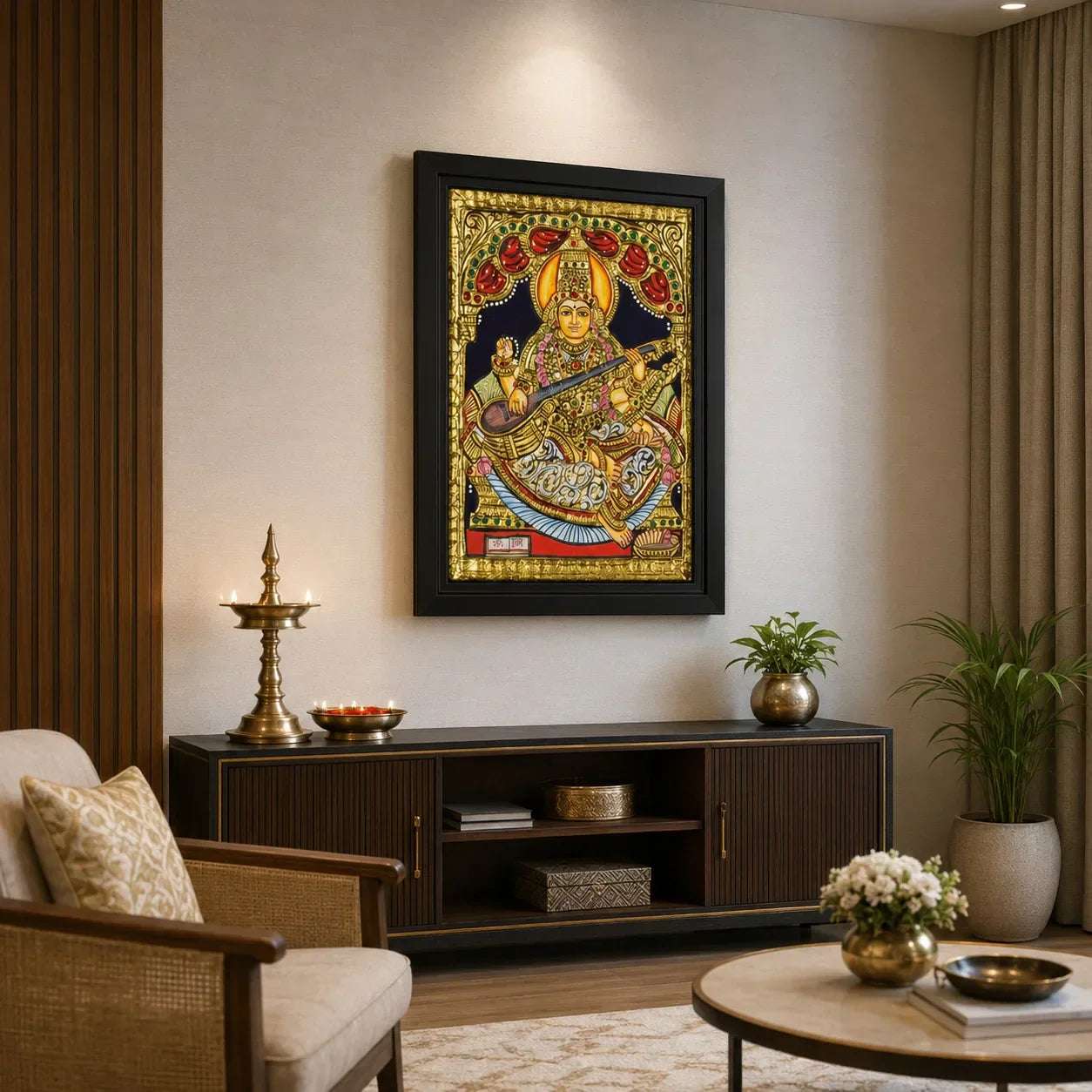
Most art bought today loses value the moment it leaves the store. A genuine Tanjore painting works differently — it's one of the rare categories of decor that can actually appreciate, get passed down, and hold its story for generations. Understanding why requires understanding what actually goes into making one, because the price difference between a genuine piece and a mass-produced imitation isn't decoration — it's material, labor, and lineage.
What Makes a Tanjore Painting "Genuine"
A Tanjore painting isn't paint on canvas in the way most art is. It begins with a wooden base, layered with cloth and a gesso paste made from chalk powder and gum, built up into raised relief work that gives the painting its signature three-dimensional depth. Once the gesso work is dry, artisans apply gold foil by hand over the raised sections, then set semi-precious stones — traditionally rubies, emeralds, and pearls — into the composition before the final detailing in paint.
This is not a quick process. A single painting can take weeks of meticulous, layered work by a trained artisan, often someone from a family that has practiced this exact technique for generations. Avyaan's own Tanjore work, for instance, comes from artisans like Lakshmi Devi, one of the few women master artisans still preserving this tradition, whose family's method of applying gold foil over gesso work is what gives each piece its distinctive luminosity.
How 22 Karat Gold Is Used in the Painting
This is the detail most buyers don't fully understand, and it's central to the value of 22k gold foil Tanjore painting pieces specifically. The gold used isn't paint or a gold-toned pigment — it's genuine 22 karat gold, hammered into extremely thin foil sheets and applied by hand directly onto the raised gesso relief.
Here's how the process actually works:
-
Gesso relief is built first. The artisan builds up the design in raised, three-dimensional gesso work — crowns, jewelry, borders, and ornamental details are sculpted before any gold touches the surface.
-
Gold foil is applied by hand. Thin sheets of 22k gold are carefully laid over the raised sections using a natural adhesive, then gently pressed and smoothed so the foil follows every contour of the relief work underneath.
-
The foil is burnished. Artisans burnish the gold to bring out its shine and ensure it adheres permanently to the gesso, rather than sitting loosely on top.
-
Semi-precious stones are set into the composition, usually around the deity's crown, jewelry, or border, adding both visual richness and material value to the piece.
Because the gold is a real precious metal rather than a synthetic imitation, it doesn't fade, discolor, or peel the way gold-toned paint or cheaper metal foils do over time. This is also why genuine Tanjore paintings develop a deeper, warmer glow with age rather than dulling — the gold itself doesn't degrade.
Original Tanjore Painting Cost Factors
If you've been comparing prices and wondering why two Tanjore paintings that look similar can be priced so differently, the original Tanjore painting cost factors usually come down to a few specific variables:
Gold purity and coverage. A painting with dense gold foil work across a large surface area costs significantly more than one with minimal gold accents, simply due to the quantity of actual precious metal used.
Stone quality. Genuine semi-precious stones cost more than glass or synthetic substitutes, and the number and size of stones set into a piece directly affects price.
Size and composition complexity. A large painting with multiple figures, intricate borders, and detailed relief work takes considerably longer to complete than a simple single-deity composition.
Artisan lineage and skill. Work from a recognized master artisan family, especially one with a documented multi-generational history in the craft, commands a premium — much like signed work in any fine art category.
Framing. Genuine Tanjore paintings are traditionally sold framed as standard, and the quality of the wood frame itself factors into the final price.
A painting priced dramatically below typical market range for its size is almost always a signal that one or more of these elements has been substituted — thinner gold, synthetic stones, or machine-printed detailing rather than genuine hand relief work.
Luxury Tanjore Art for Corporate Gifting
Tanjore paintings have become an increasingly popular choice for luxury Tanjore art for corporate gifting, particularly for milestone occasions — a company anniversary, a senior leadership transition, or gifts for international clients and partners. A few reasons this category works especially well in a corporate context:
It photographs and displays exceptionally well in an office or boardroom setting, where the raised gold relief catches light differently throughout the day, giving the piece a dynamic presence that flat art can't match.
It carries cultural weight without being overtly religious when the composition is chosen thoughtfully — pieces like Gaja Lakshmi (prosperity) or Ganesha (new beginnings) work well as gifts that read as auspicious and celebratory rather than strictly devotional, making them appropriate even for recipients outside India.
Each piece comes with a documented story — the artisan, the technique, the tradition — which gives corporate gifting a narrative depth that a generic luxury item doesn't have. A framed digital certificate of authenticity, naming the artisan and craft lineage, elevates the gift from decorative to meaningful.
It scales across price points, from a modestly sized single-deity composition suitable for a client gift, to a large, elaborately detailed piece suitable for a landmark corporate milestone or a leadership retirement gift. Avyaan's own range reflects this spread — pieces like Grace of Beginnings: Ganesha in Tanjore work well as an individual client or team gift, Radiance of Prosperity: Gaja Lakshmi in Tanjore suits a mid-tier gifting budget with a strong prosperity theme, and a larger, more elaborate work like Sheshayi Vishnu with Sridevi and Bhudevi in Tanjore is suited to a landmark corporate milestone.
Why Tanjore Paintings Appreciate Rather Than Depreciate
Most decorative purchases lose value because they're mass-manufactured and infinitely reproducible. A genuine Tanjore painting resists this for a simple reason: it's handmade, one artisan's interpretation of a composition, using a fixed and diminishing quantity of real gold and stone. As fewer artisan families continue practicing the full traditional technique — the gesso relief work, hand-applied gold, hand-set stones — genuine pieces from documented master artisans become scarcer, not more available, over time.
This is the same logic that applies to fine jewelry or collectible craft in any culture: material value plus artisan scarcity plus documented provenance equals an asset that holds and often increases in worth, rather than a purchase that depreciates the day it's unboxed.
What to Check Before You Buy
Before investing in a Tanjore painting as more than decor, verify a few things:
- Ask specifically whether the gold used is genuine 22 karat foil, not gold-toned paint or a lower-karat substitute.
- Confirm whether the stones are genuine semi-precious stones or glass/synthetic imitations.
- Look for documented artisan information — a name, a family lineage, a region — rather than a generic "handcrafted in India" label.
- Request a certificate of authenticity that names the artist and verifies the craft tradition, so the piece's provenance is documented from the point of purchase.
A Piece of Heritage, Not Just a Painting
A genuine Tanjore painting isn't priced the way it is because of markup — it's priced according to the real gold, real stones, and real hours of a skilled artisan's hands that went into it. That's precisely what makes it different from almost every other decorative purchase available today: it's an asset built on scarce material and disappearing craft knowledge, which is exactly the combination that tends to hold and grow in value over a lifetime, rather than lose it.
Frequently Asked Questions (FAQs) - Tanjore Paintings
Q1. Why are Tanjore paintings so costly?
Ans: तंजौर पेंटिंग (Tanjore Paintings) के महंगे होने का मुख्य कारण इसमें इस्तेमाल होने वाली बहुमूल्य सामग्री और कड़ी मेहनत है। इन पेंटिंग्स में असली 22-कैरेट सोने के वर्क (Gold Foil) और अर्ध-कीमती जयपुर पत्थरों (Semi-precious stones) का उपयोग किया जाता है। साथ ही, कुशल कारीगरों द्वारा इसे पूरी तरह से हाथ से तैयार करने में कई दिनों या हफ्तों का समय लगता है, जो इसे एक अनूठी कलाकृति बनाता है।
Q2. How to identify an original Tanjore painting?
Ans: असली तंजौर पेंटिंग की पहचान उसके रिलीफ वर्क (Embossed Texture) और सोने की चमक से होती है। असली 22k सोने का वर्क समय के साथ कभी काला नहीं पड़ता और वह एक विशिष्ट शाही चमक देता है। इसके अलावा, प्रामाणिक पारंपरिक पेंटिंग्स में कभी भी सिंथेटिक प्लास्टिक पत्थरों के बजाय प्राकृतिक पत्थरों का उपयोग किया जाता है। अगर पेंटिंग पर बहुत तेज या नकली चमक दिखे, तो वह नकली हो सकती है।
Q3. Do Tanjore paintings use real gold?
Ans: हाँ, पारंपरिक और प्रामाणिक तंजौर पेंटिंग्स में असली 22-कैरेट सोने की परतों (Gold Leaves/Foils) का उपयोग किया जाता है। यह सोना पेंटिंग के एम्बोस्ड (उभरे हुए) हिस्से पर चिपकाया जाता है। असली सोने का उपयोग करने के कारण ही ये पेंटिंग्स पीढ़ियों तक (100 से अधिक वर्षों तक) बिना अपनी चमक खोए सुरक्षित रहती हैं।
Q4. Is Tanjore painting good for home Vastu?
Ans: वास्तु शास्त्र के अनुसार, घर में तंजौर पेंटिंग रखना बेहद शुभ माना जाता है। इसमें मुख्य रूप से हिंदू देवी-देवताओं (जैसे भगवान कृष्ण, लक्ष्मी जी और गणेश जी) के दिव्य रूपों को दर्शाया जाता है। असली सोने और सकारात्मक कलाकृति के कारण, यह घर में सुख, समृद्धि, धन और सकारात्मक ऊर्जा (Positive Vibes) को आकर्षित करती है। इसे लिविंग रूम या पूजा घर की उत्तर या पूर्व दीवार पर लगाना सबसे अच्छा होता है।
Q5. How do you clean and maintain a Tanjore painting?
Ans: तंजौर पेंटिंग की देखभाल के लिए इसे हमेशा कांच के फ्रेम (Glass Framing) के साथ ही रखना चाहिए। इसे कभी भी सीधे पानी या गीले कपड़े से साफ न करें। यदि फ्रेम के अंदर धूल चली जाए, तो उसे हल्के सूखे मखमली या सूती कपड़े से साफ करें। पेंटिंग को सीधे धूप और अत्यधिक नमी वाली दीवारों से दूर रखें ताकि इसकी लकड़ी और बोर्ड खराब न हो।
Q6. What is the history and origin of Tanjore art?
Ans: तंजौर पेंटिंग की उत्पत्ति 16वीं शताब्दी में चोल राजवंश के दौरान तमिलनाडु के तंजावुर (Tanjore) शहर में हुई थी। बाद में मराठा राजाओं, नायक राजाओं और राजा सरफोजी II के संरक्षण में इस कला का बहुत विकास हुआ। यह कला अपनी अनूठी तकनीक, जीवंत रंगों, भारी एम्बोस्ड कोटिंग और समृद्ध सोने के काम के लिए दुनिया भर में प्रसिद्ध है।


![[Product Title] - Avyaan](http://aavyaan.com/cdn/shop/files/Grace_of_Beginnings_Ganesha_in_Tanjore_Gold_800x800_5057dc37-751a-4085-b2c1-a1a947001f54.webp?v=1784792848&width={width})
![[Product Title] - Avyaan](http://aavyaan.com/cdn/shop/files/Mockup_Ganga_Avataran_1.png?v=1784793858&width={width})
![[Product Title] - Avyaan](http://aavyaan.com/cdn/shop/files/26.png?v=1784792915&width={width})
![[Product Title] - Avyaan](http://aavyaan.com/cdn/shop/files/Tanjore-radhakrishna-png_1.webp?v=1784792858&width={width})
![[Product Title] - Avyaan](http://aavyaan.com/cdn/shop/files/Mockup_3.2_1-1.png?v=1784794004&width={width})
![[Product Title] - Avyaan](http://aavyaan.com/cdn/shop/files/Radiance_of_Prosperity_Gaja_Lakshmi_in_Tanjore_Splendor_2.webp?v=1784792826&width={width})
![[Product Title] - Avyaan](http://aavyaan.com/cdn/shop/files/29.png?v=1784792820&width={width})