Quick Answer
The best way to understand how to identify original Tanjore painting is to examine its physical construction, gold work, surface depth, handmade details, artist information and provenance rather than judging authenticity from appearance or price alone.
Buying traditional Indian art is not simply a matter of choosing a beautiful picture. For collectors and first-time buyers, the real challenge is understanding how to identify original Tanjore painting, distinguishing handmade artwork from reproductions, and determining whether the Tanjore paintings price reflects genuine craftsmanship and materials.
The same concern applies when you want to buy Pichwai painting online, purchase authentic Bhil artwork, or compare a handmade painting with a digitally printed reproduction.
At first glance, an original artwork and a high-quality printed copy can look remarkably similar. Their materials, construction, artistic process, texture and long-term significance, however, can be very different.
How to Spot a Fake Tanjore Painting Before You Pay?
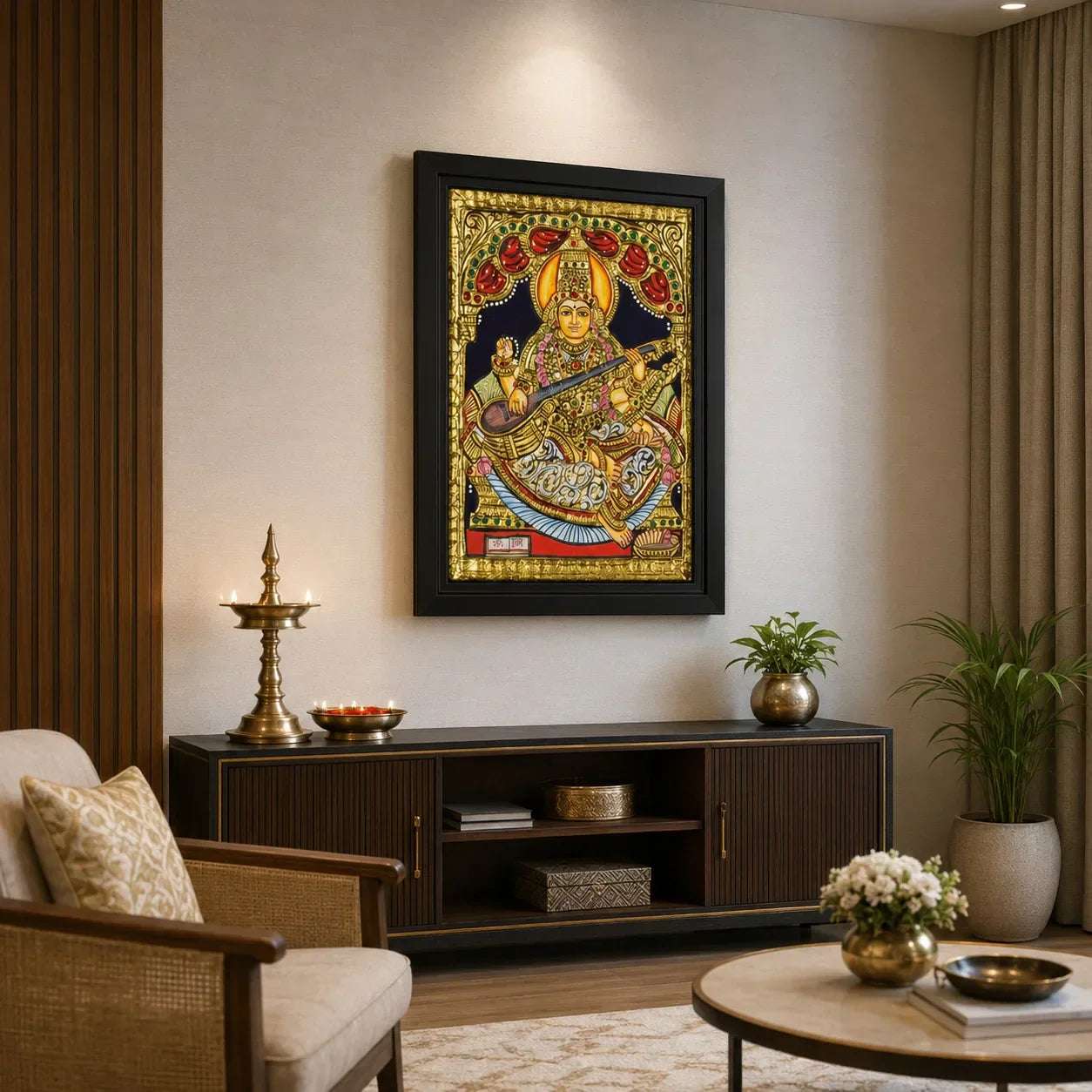
Tanjore painting, also known as Thanjavur painting, is one of the most recognizable traditional art forms of South India. It is particularly known for devotional subjects, vibrant colours, ornamental detailing, raised relief work and the use of gold leaf.
The popularity of Tanjore art has also created a market for printed designs and reproductions that imitate the appearance of traditional artwork without following the same artistic process.
1. Examine the Surface Texture
One of the first things to examine is the physical depth of the artwork. Traditional Tanjore paintings commonly feature raised areas that create dimensionality within the composition.
Look closely at crowns, jewellery, ornaments, borders and other decorative sections. Under angled light, genuine relief work creates subtle shadows and highlights that a completely flat print cannot reproduce.
2. Look Closely at the Gold Work
Gold is one of the defining visual characteristics of Tanjore painting. However, simply seeing a golden colour does not automatically establish that genuine gold leaf has been used.
Ask the seller what type of gold leaf has been used, how it was applied, and which areas of the painting contain gold.
The 22-Karat Real Gold Leaf Test for Thanjavur Art
Material Focus
Why Gold Leaf Matters
Traditional Thanjavur paintings are strongly associated with gold ornamentation applied over prepared raised sections of the artwork. The quality and application of this material can significantly influence the appearance and craftsmanship of a painting.
If a seller specifically claims that a painting uses 22-karat gold leaf, ask for clear material specifications or supporting information. Visual appearance alone cannot scientifically establish gold purity.
Avoid scratching, scraping, burning or applying chemicals to an artwork as a home test. Such methods can permanently damage valuable artwork.
Tanjore Paintings Price: What Determines the Cost?
Searching for a Tanjore painting price list can be confusing because there is no single price that applies to every authentic Tanjore painting.
Two paintings of a similar size can have very different prices because of differences in materials, gold work, complexity, artist, craftsmanship and provenance.
Factors That Can Increase Value
- Handmade construction
- Gold leaf and material quality
- Complexity of composition
- Detailed relief work
- Artist or artisan expertise
- Provenance and documentation
What Buyers Should Ask
- What exactly is handmade?
- What gold has been used?
- Who created the painting?
- What materials were used?
- Is it original or reproduced?
- Can I see it live before buying?
Buying traditional Indian art requires understanding how to identify original Tanjore painting, distinguishing handmade artwork from reproductions, and determining whether the Tanjore paintings price reflects genuine craftsmanship. The same applies when you want to buy Pichwai painting online or purchase authentic Bhil artwork.
How to Spot a Fake Tanjore Painting Before You Pay?
Traditional Tanjore paintings feature raised relief work, vibrant colours, and gold leaf.
-
Surface Texture: Genuine relief work creates subtle shadows and highlights under angled light that a flat print cannot reproduce.
-
Gold Work: Real gold leaves show tiny organic imperfections or fine lines from hand-application, unlike smooth machine prints.
Tanjore Paintings Price & Authentic Art Value
Key factors determining authentic art value include 22-karat real gold leaf, intricate gesso paste relief work, and extensive artisan execution time.
Checking Authentic Pichwai & Bhil Art
Handmade Pichwai and Bhil artworks contain physical brush marks, unique dot patterns, and subtle organic variations absent in digital reproductions.
Instead of asking only "How much does a Tanjore painting cost?", ask what you are actually paying for.
How to Check Authentic Pichwai Art and Avoid Digital Copies?
Pichwai painting is a traditional Indian art form historically associated with the devotional culture surrounding Shrinathji at Nathdwara.
Today, Pichwai-inspired imagery is widely available online. This makes it particularly important for buyers who want to buy Pichwai painting online to understand exactly what they are purchasing.
01
Examine the Brushwork
Look closely at leaves, flowers, animals, facial features and decorative patterns. Handmade work contains physical brush marks and subtle variations that are not present in the same way in a digital reproduction.
02
Check the Painting Surface
Ask what surface the artwork was created on and examine it through detailed photographs or a live video. Texture alone is not absolute proof because modern printing techniques can imitate textured surfaces.
03
Study Repeated Motifs
Handmade repeated motifs can contain small differences because they are individually painted. Digital reproductions reproduce the same image mechanically.
04
Ask Whether It Is Original
Ask the seller directly whether the artwork is hand-painted, original or reproduced. Honest product descriptions help buyers make informed decisions.
Printed Copy vs Original Painting: What Is the Difference?
The difference between a printed copy vs original painting is fundamentally the difference between reproducing an image and physically creating an artwork.
Original Handmade Painting
- Created physically by an artist
- Individual brushwork
- Hand-applied details
- Natural variations
- Physical layers and texture
- Unique execution
Printed Reproduction
- Existing image reproduced
- Digitally transferred details
- Repeated image structure
- Generally flat image surface
- Can be reproduced multiple times
- Primarily decorative
A printed artwork is not automatically a bad product. It can be an accessible decorative option when it is accurately described as a reproduction.
The important distinction is honest representation. A buyer should know whether they are purchasing an original handmade artwork or a reproduction before paying.
Differentiating an Organic Bhil Painting from a Printed Replica
Bhil art is associated with Bhil tribal communities of India and is known for distinctive visual approaches, including rhythmic compositions and characteristic dot-based patterns.
For collectors searching for authentic Bhil art peacock, the presence of a familiar motif is not enough to establish authenticity. A peacock can be digitally reproduced thousands of times.
Examine the Dots
Look at their spacing, size and application. Handmade work can show subtle differences because individual marks are created by the artist.
Look for Natural Variations
Hand-painted artwork can contain differences in dot size, spacing, brush pressure, colour density and line characteristics.
Understand the Artist's Context
Ask who created the artwork, where it was made, what materials were used, and whether the work is handmade and original.
What Should You Ask Before Buying Traditional Indian Art Online?
Before placing an order, ask specific questions rather than simply asking whether a painting is "original."
Tanjore Paintings
- Is the artwork handmade?
- What type of gold leaf has been used?
- Is the gold claimed to be 22-karat?
- Who created the painting?
- Can you provide close-up photographs?
- Can I see the painting through a live video call?
How to Identify Original Tanjore Painting? (5 Crucial Authenticity Checks)
Tanjore paintings are a premium lifelong investment, but with so many modern fakes in the market, art collectors must know how to test authenticity before buying. Authentic Tanjore art is deeply rooted in history and crafted using traditional techniques that cheap replicas cannot copy.
1. Check the Pure 22-Karat Gold Foil
Original Tanjore paintings always use real 22-karat gold leaf. Real gold never loses its shine or fades over decades. If the gold work looks overly shiny like plastic foil or turns dark/blackish after a few months, it is a chemical imitation fake.
2. Inspect the Relief Work (Gesso Paste)
The iconic 3D embossed look of Tanjore art comes from a traditional paste made of unboiled limestone dust and tree soluble muck (Gesso paste). In authentic pieces, this relief work is intricately done by hand. Fake variants often use cheap chalk powder or pre-molded plastic sheets that crack easily over time.
3. Look closely at the Gemstones
Traditional paintings feature semi-precious Jaipur stones or glass beads that reflect light beautifully under different angles. Replicas use cheap plastic stones or acrylic beads that look dull and scratch easily.
Why Authentic Tanjore Paintings Are So Costly?
Many art lovers ask, "why are Tanjore paintings so costly?" The price reflects the extreme skill and time required to make them. A single genuine piece takes anywhere from three weeks to three months to complete. When you buy an authentic piece, you are not just purchasing a canvas painting; you are buying pure gold leaf work and a legacy of dedicated craftsmanship that lasts for generations.
Pichwai Paintings
- Is this hand-painted or printed?
- Who is the artist?
- What surface has been used?
- Can I see close-ups of the brushwork?
- Is the artwork an original or reproduction?
Bhil Art
- Who is the artist?
- Is the artwork handmade?
- What materials were used?
- Are the motifs individually painted?
- Can you provide detailed close-up images?
Common Mistakes Buyers Make When Purchasing Traditional Art
Mistake 1: Assuming a High Price Means Authenticity
Price is not proof of authenticity. A buyer should evaluate materials, craftsmanship and provenance.
Mistake 2: Assuming Golden Colour Means Real Gold
Gold-coloured materials can imitate the appearance of genuine gold.
Mistake 3: Judging From a Thumbnail
Small product images can hide important details. Always request close-up views for valuable artwork.
Mistake 4: Never Asking About the Artist
Artist information can provide valuable context about the artwork.
Mistake 5: Confusing Traditional Style With Traditional Original
A modern print inspired by a traditional style is not necessarily an original traditional artwork.
Mistake 6: Ignoring Seller Transparency
Sellers who provide clear information, close-ups and live verification give buyers more confidence than sellers who avoid specific questions.
Expert Questions About Traditional Indian Art
Why do original Tanjore paintings demand a high price premium in the art market?
Original Tanjore paintings can command higher prices because their value can include handmade preparation, raised relief work, specialised ornamentation, gold leaf, detailed craftsmanship, artist expertise and provenance. The time and skill required to create an individual handmade painting can be substantially greater than the resources required to reproduce an existing image digitally.
How can a collector differentiate between an organic Bhil painting and a digital replica?
Examine the physical execution of the artwork. Individual dots, lines, shapes and colour applications can show subtle variations in handmade work. A digital replica reproduces an existing image. Collectors should combine visual inspection with artist information, material details and provenance rather than relying on a single visual characteristic.
What is the significance of the Durga Slaying Mahishasura artwork in traditional Pattachitra?
The depiction of Durga defeating Mahishasura represents the victory of divine power over destructive forces. In Pattachitra traditions, mythological and devotional narratives are expressed through stylised compositions, strong outlines, decorative borders and carefully controlled visual details. The subject connects the artwork with a larger cultural and religious narrative.
Final Checklist Before Buying an Original Indian Painting
Authenticity
- Is it original or printed?
- Is it handmade?
- Is the artist identified?
Materials
- What surface has been used?
- What paints and materials are used?
- Does the artwork contain genuine gold leaf?
- What gold purity is claimed?
Craftsmanship
- Can you see brushwork?
- Is there physical depth?
- Are decorative elements individually executed?
Verification
- Can you see detailed photographs?
- Can the seller provide a live video?
- Can you ask questions before purchasing?
Price
- Does the price correspond to the materials and craftsmanship?
- Are you comparing an original with another original?
- Are you accidentally comparing an original with a reproduction?
Conclusion: Look Beyond the Image
Learning how to identify original Tanjore painting is ultimately about learning to look beyond the image.
The same principle applies when you want to buy Pichwai painting online, evaluate an authentic Bhil art peacock, or understand the difference between a printed copy vs original painting.
Look at the physical construction. Ask about materials. Examine the surface. Investigate the artist. Understand the production process. Most importantly, ask whether the artwork is genuinely handmade or simply a reproduction of an existing image.
The objective is not simply to find the most expensive painting. It is to understand what you are buying and why it has the value claimed by the seller.


![[Product Title] - Avyaan](http://aavyaan.com/cdn/shop/files/Grace_of_Beginnings_Ganesha_in_Tanjore_Gold_800x800_5057dc37-751a-4085-b2c1-a1a947001f54.webp?v=1784792848&width={width})
![[Product Title] - Avyaan](http://aavyaan.com/cdn/shop/files/Mockup_Ganga_Avataran_1.png?v=1784793858&width={width})
![[Product Title] - Avyaan](http://aavyaan.com/cdn/shop/files/26.png?v=1784792915&width={width})
![[Product Title] - Avyaan](http://aavyaan.com/cdn/shop/files/Tanjore-radhakrishna-png_1.webp?v=1784792858&width={width})
![[Product Title] - Avyaan](http://aavyaan.com/cdn/shop/files/Mockup_3.2_1-1.png?v=1784794004&width={width})
![[Product Title] - Avyaan](http://aavyaan.com/cdn/shop/files/Radiance_of_Prosperity_Gaja_Lakshmi_in_Tanjore_Splendor_2.webp?v=1784792826&width={width})
![[Product Title] - Avyaan](http://aavyaan.com/cdn/shop/files/29.png?v=1784792820&width={width})