Indian Textile Heritage
Patola: The Gujarati Textile That Looks Printed — But Isn't
What makes Patola so expensive? Why does the pattern look almost impossibly precise? And how can you tell authentic Patola from a printed imitation?
Looking for Authentic Patan Patola?Now that you know the rich history of Ikat and Patola, explore our ready-to-ship collection of genuine hand-woven
Patola Dupattas and
Patan Patola Clutches. Crafted meticulously by traditional artisans.
👉 Shop Pure Silk Patola Dupattas & Clutches Here
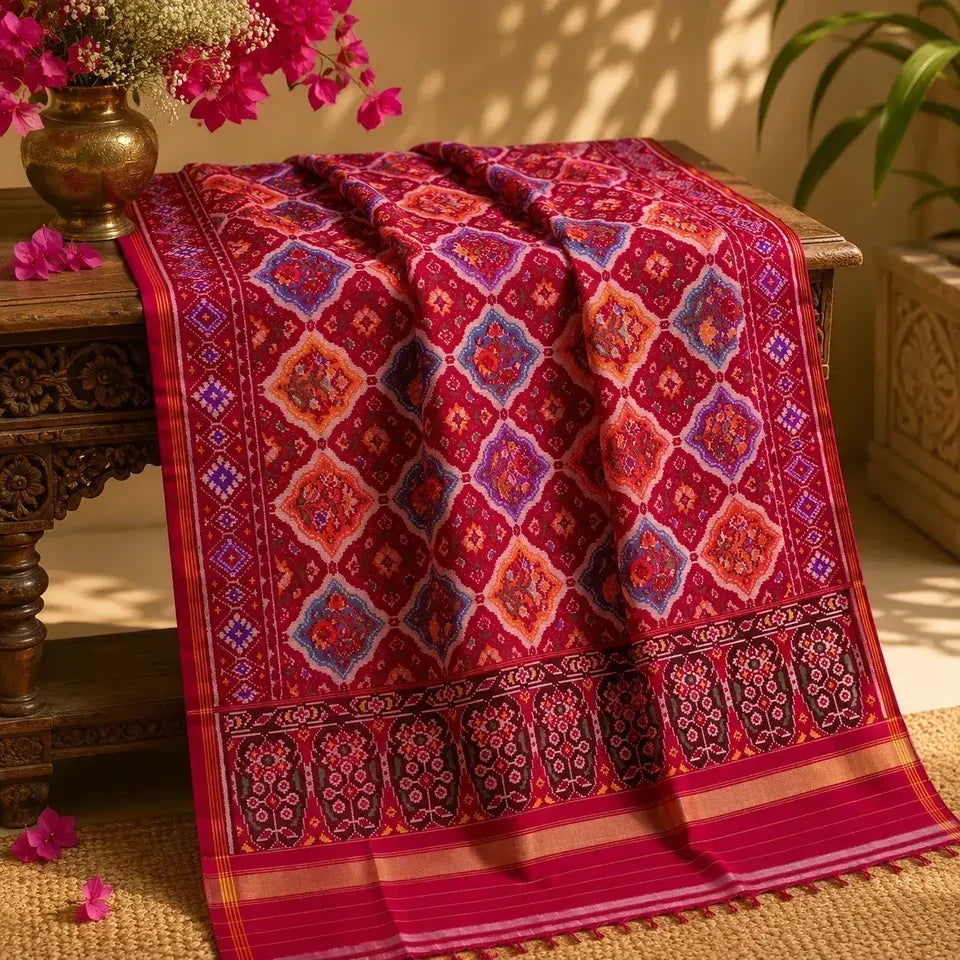
At first glance, Patola can look like a beautifully printed textile. The colours are sharp. The motifs appear remarkably precise. The pattern seems to sit perfectly on the surface.
But there is a detail most people don't realise: the design is not simply printed onto the finished fabric.
In traditional Patan Patola, both the warp and weft threads are individually prepared and resist-dyed before they are woven together using the demanding double-ikat technique. The final design emerges from the precise alignment of those threads during weaving.
Before You Buy Patola, Ask One Question
“Am I buying a Patola-inspired print, or am I buying a textile made using the Patola weaving tradition?”
That single question can completely change how you look at Patola.
What Is Patola?
Patola is a traditional textile associated particularly with Patan, Gujarat. Patan Patola is recognised for its double-ikat weaving technique, in which both warp and weft threads are resist-dyed according to the intended design before weaving.
The craft is not simply about making a colourful fabric. It requires planning the design at the thread level before the loom ever creates the final pattern.
This is one of the reasons Patan Patola has been valued as a highly skilled textile tradition for generations.
Quick Answer
Patola is a traditional Gujarati textile, especially associated with Patan, made using an intricate ikat process. Patan Patola is particularly known for its double-ikat technique, where both warp and weft are resist-dyed before weaving.
Why Is Patola So Expensive?
This is probably the first question people ask when they see the price of an authentic Patola textile.
And the answer is not simply “because it is traditional.”
The real reason is how much work happens before the finished textile exists.
In double ikat, the pattern has to be planned into the yarn itself. Warp and weft threads are tied and dyed before weaving, and the resulting design depends on their careful alignment on the loom.
Government and cultural sources describe Patan Patola as a highly laborious textile tradition, with some pieces taking many months to complete.
Think About It This Way
A printed textile starts with a finished surface and adds a design to it.
Patola begins working on the threads before the final textile is even woven.
Want to See Patola Craftsmanship for Yourself?
Explore the Patola textiles and handcrafted pieces available from Avyaan.
Explore Patola Collection
What Is Double Ikat in Patola?
The word “double” is important.
In a double-ikat textile, both the warp and weft are prepared through resist dyeing. These threads are then brought together during weaving so that the intended pattern appears in the finished fabric.
This is what makes Patan Patola so fascinating: the weaver is not merely following a design after the fabric has been made. The design is being engineered through the preparation and positioning of the threads themselves.
Why Does Patola Look Almost Like It Has Been Printed?
This is one of the most interesting things about Patola.
The precision of the woven pattern can make the textile appear printed at first glance. But the visual effect comes from the dyed warp and weft threads meeting to form the final design.
Look closely at the textile and you begin to appreciate the difference. You are not simply looking at colour placed on fabric. You are looking at colour engineered into the structure of the weave.
What Makes Patan Patola Different From Ordinary Ikat?
Ikat is a broader textile technique found in different parts of India and the world. Patan Patola is particularly famous for its double-ikat approach, where both warp and weft are resist-dyed before weaving.
Gujarat also has other ikat traditions, including single-ikat textiles from parts of the state. Gujarat Tourism notes that these can be more economical and generally have simpler patterns than Patan's intricate double-ikat textiles.
Simple distinction:
Single Ikat → one set of threads is resist-dyed before weaving.
Double Ikat → both warp and weft are resist-dyed before weaving.
What Are the Traditional Patola Motifs?
Patola is recognised for its geometric, floral and figurative designs. Historical and museum documentation includes motifs such as the pan bhat or pipal-leaf pattern, while traditional Patola design vocabulary also includes animal, floral and geometric forms.
Depending on the design, you may encounter motifs inspired by:
- Flowers and plants
- Pipal leaves
- Parrots and other birds
- Elephants
- Geometric forms
- Figurative and repeated patterns
These motifs are not simply decoration. They are part of the visual vocabulary that makes traditional Patola instantly recognisable.
How Can You Identify Authentic Patola?
This is where things become practical.
If you are planning to buy Patola online, you should not rely on colour or pattern alone. A beautiful pattern does not automatically prove that a textile is handwoven Patola.
1. Ask About the Weaving Technique
Ask whether the product is genuinely woven using the stated Patola or double-ikat technique, rather than simply printed with a Patola-inspired design.
2. Ask About the Origin
If the product is being sold specifically as Patan Patola, ask for clear information about its origin and authenticity. Patan Patola has registered Geographical Indication status in India.
3. Understand the Material
Traditional Patan Patola is particularly associated with silk textiles. Government documentation describes Patan Patola as a double-ikat silk textile.
4. Ask for Product Details
A trustworthy seller should be able to explain what you are buying, including material, technique, dimensions and craftsmanship.
Still Looking for the Right Patola Piece?
If you already know you want Patola craftsmanship rather than just a printed pattern, take a look at the available pieces.
View Available Patola Pieces
Why Do People Still Value Patola Today?
Trends change quickly.
But some textiles survive because the value is not dependent only on fashion.
Patola carries together craftsmanship, regional identity, technical skill and visual heritage.
The Patan Patola tradition has been preserved through generations of weaving families. Gujarat Tourism's Patan Patola Heritage Museum describes the Salvi family's continued practice of double-ikat weaving over many generations.
That makes a Patola piece interesting not only as something to wear or carry, but also as a way of keeping a traditional Indian textile craft visible in contemporary life.
Patola Is Not Just About the Final Product
Imagine looking at a finished Patola textile and knowing that its pattern had to be considered before the threads were woven together.
Suddenly, the price makes a little more sense.
The colours make more sense.
The precision makes more sense.
And perhaps most importantly, the textile stops looking like just another beautiful piece of fabric.
You start seeing the planning, patience and skill inside it.
Frequently Asked Questions About Patola
What is Patola?
Patola is a traditional Gujarati textile, especially associated with Patan, and Patan Patola is renowned for its double-ikat weaving technique.
What is Patan Patola?
Patan Patola refers to the Patola textile tradition associated with Patan in Gujarat. Patan Patola has registered Geographical Indication status in India.
Why is Patola so expensive?
The price reflects the complex preparation and weaving process, skilled manual work, materials and time involved in producing the textile.
What is double ikat?
Double ikat is a resist-dyeing technique in which both warp and weft threads are prepared and dyed before weaving.
How can I identify authentic Patola?
Look for clear information about the origin, material, weaving technique, craftsmanship and seller's authenticity documentation. Do not judge authenticity only by the appearance of the pattern.
Is Patola the same as Ikat?
Patola uses the ikat technique, but Patan Patola is particularly known for double ikat, where both warp and weft are resist-dyed before weaving.
Where does Patola come from?
Patan in Gujarat is especially renowned for the Patan Patola double-ikat tradition. Other ikat traditions also exist in Gujarat and elsewhere in India.
Want to Own a Piece of the Tradition?
Now that you know what makes Patola different, explore the available handcrafted Patola collection.
Shop Patola Collection
Patola is a traditional textile heritage of Gujarat. Specific designs, materials, techniques and production practices can vary between products and traditions. Product descriptions should always be checked for the exact item being purchased.


![[Product Title] - Avyaan](http://aavyaan.com/cdn/shop/files/Grace_of_Beginnings_Ganesha_in_Tanjore_Gold_800x800_5057dc37-751a-4085-b2c1-a1a947001f54.webp?v=1784792848&width={width})
![[Product Title] - Avyaan](http://aavyaan.com/cdn/shop/files/Mockup_Ganga_Avataran_1.png?v=1784793858&width={width})
![[Product Title] - Avyaan](http://aavyaan.com/cdn/shop/files/26.png?v=1784792915&width={width})
![[Product Title] - Avyaan](http://aavyaan.com/cdn/shop/files/Tanjore-radhakrishna-png_1.webp?v=1784792858&width={width})
![[Product Title] - Avyaan](http://aavyaan.com/cdn/shop/files/Mockup_3.2_1-1.png?v=1784794004&width={width})
![[Product Title] - Avyaan](http://aavyaan.com/cdn/shop/files/Radiance_of_Prosperity_Gaja_Lakshmi_in_Tanjore_Splendor_2.webp?v=1784792826&width={width})
![[Product Title] - Avyaan](http://aavyaan.com/cdn/shop/files/29.png?v=1784792820&width={width})