Free Shipping & All Taxes Included – No Hidden Fees
Authentic. Handcrafted. Yours. — Shop Avyaan
Celebrate Indian heritage — handcrafted art for every home, every occasion
Made to order means made for you — explore our collections today
Give the gift of living craft — custom gifting available | WhatsApp +91 90162 33045
GI-Tagged. Handcrafted. Made to Order. — Welcome to Avyaan
We've sent you an email with a link to update your password.
Reset your password
We will send you an email to reset your password.
Raja Ravi Varma Oleographs Price Guide: 5 Secrets Behind Antique Art Valuation
Hetuk Desai
0 comments
What makes one Raja Ravi Varma oleograph more valuable than another? Look beyond the image itself. The print’s provenance, condition, subject, size and printing characteristics all deserve a closer look.
If you plan to buy ravi varma oleographs, understanding antique art valuation helps you ask better questions before committing. This guide breaks the process into five practical checks for collectors browsing antique indian paintings for sale, with particular attention to historic prints and their documentation.
The short answer
Evaluate the whole piece, not a single sign of age. A press inscription, aged paper or layered ink can be useful evidence, but none of these alone establishes authenticity or market value.
Start with clear photographs of the front, reverse and margins, then review the seller’s documentation and condition details.
1. Scarcity and surviving supply
Historic prints are different from newly produced reproductions: the supply of surviving period examples is limited. However, scarcity is meaningful only when considered alongside demand, condition and documented provenance.
Before paying a rarity premium, ask what makes this particular example unusual. Is it the subject, format, edition, preservation or ownership history? A description such as “rare” should be supported by details, not simply repeated in a listing.
Buyer’s takeaway: Ask why this particular print is scarce. Age alone does not guarantee appreciation or protect against a fall in value.
2. Read the Ravi Varma Press inscriptions
The lower margins may contain publishing credits, press locations and registration details. These are worth examining alongside the print’s overall physical characteristics and supporting records.
Ravi Varma Press, Karla-Lonavla: Record the exact wording and request a sharp close-up.
Ravi Varma Press, Ghatkopar, Bombay: Compare the inscription with documented examples rather than relying on a seller’s description alone.
Registration markings: Photograph any numbers or credits and assess them as part of the wider evidence.
Missing or cropped margins can remove useful information. Blurred lettering may also warrant closer inspection, but an inscription can itself be reproduced, so its presence is not proof of authenticity.
Buyer’s takeaway: Request uncropped margin photographs and ask for the basis of the seller’s attribution.
3. Assess paper condition and chemical oxidation
Look at both sides of the artwork. Discolouration, staining, tears, creases, repairs and mounting can affect how a print looks and how it should be valued.
When sellers discuss chemical oxidation, ask how that observation supports their assessment of the paper. A cream, amber or brown tone may be consistent with ageing, but colour alone cannot reliably date paper. Storage conditions, restoration and artificial ageing can complicate the picture.
Ask for a condition report
Are there tears, losses, fading, stains or signs of moisture?
Has the print been cleaned, retouched, backed or restored?
Is it attached to a board, and can the reverse be inspected safely?
Does the frame conceal any damaged or trimmed areas?
Buyer’s takeaway: Do not remove backing or attempt cleaning just to inspect a print. Ask a qualified paper conservator when handling could cause damage.
4. Compare subject, size and original lithograph price
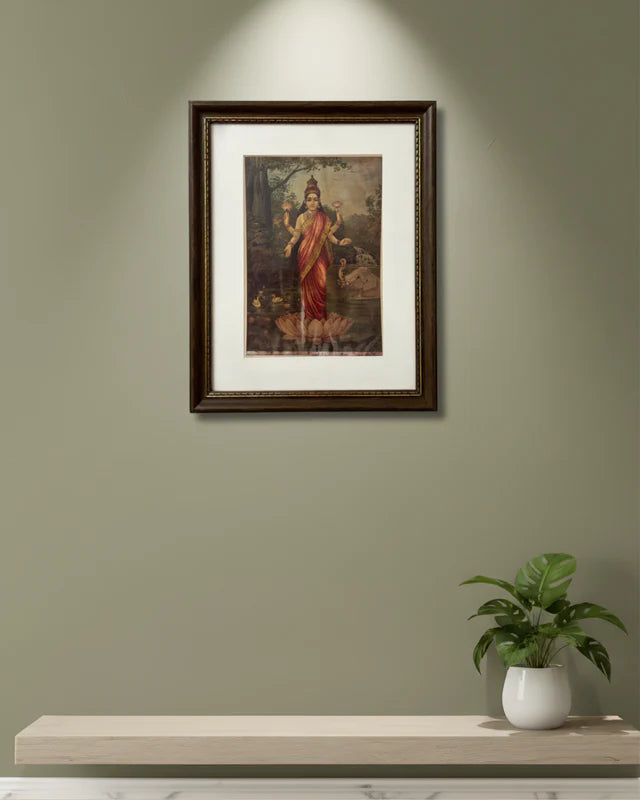
Subject matter, format, print quality, condition and provenance all influence an asking price. A Lakshmi painting and a printed depiction of the same subject are different types of artwork, so confirm exactly what the listing offers before comparing prices.
For subjects such as Saraswati or Ganga Avataran, compare examples of the same composition, medium and approximate dimensions. An unusual subject or larger format deserves closer research, not an automatic price premium.
Reading the price ranges in this guide
The earlier version of this article quoted ₹25,000–₹45,000 for familiar religious subjects and ₹60,000–₹3,00,000+ for rarer or larger examples.
These figures are not a verified current market benchmark or an appraisal. Use them only as broad context, not as a buying target or evidence of a particular print’s value.
When researching an original lithograph price, look for documented sales of similar subjects, dimensions, condition and attribution. Distinguish a seller’s asking price from a completed sale, and check whether fees, restoration or framing costs are included.
If a listing describes its asking figure as a certified heritage artwork price, ask who issued the certificate, what it verifies and whether it includes a valuation. A certificate’s scope matters more than the label.
Buyer’s takeaway: Compare like with like. A higher asking price does not establish rarity, authenticity or investment quality.
5. Examine printing details and visual texture
A 10× loupe can help you examine lettering, colour registration, paper texture and printing patterns more closely. Ask for well-lit close-up photographs if you cannot inspect the artwork in person.
When assessing a work described as a chromolithographic print, examine its visual texture alongside the seller’s explanation of the printing process. Regular dot patterns or pixelation may indicate a reproduction process. However, printing techniques vary, and the absence of obvious digital dots does not certify an original stone lithograph.
Consider these observations alongside provenance, condition, documented comparisons and specialist assessment. Avoid making a purchase decision from one magnified detail.
Buyer’s takeaway: Magnification helps you ask better questions. It is not a substitute for expert authentication.
Before you buy: a practical checklist
Request full front and reverse photographs.
Inspect all margins, publishing credits and registration details.
Confirm dimensions and whether measurements include the frame.
Ask about repairs, restoration, backing and trimming.
Review provenance and the scope of any certificate provided.
Compare relevant completed sales, not only advertised prices.
Confirm the seller’s return terms and delivery arrangements.
For a high-value purchase, consider an independent specialist assessment.
Planning to buy ravi varma oleographs?
Explore Avyaan’s artwork and ask for photographs, dimensions and available documentation before deciding.