Bhil Art Painting: History, Meaning, Animals, Peacock & Traditional Technique
Bhil art is one of India’s distinctive Adivasi art traditions, closely connected with nature, community life, stories, rituals and everyday experiences. From animals and birds to trees, rivers, fields, deities and people, Bhil paintings often turn the world around the artist into a visual story.
But what exactly is Bhil art? Why are animals so commonly seen in Bhil paintings? What does a peacock represent? Why do many Bhil paintings have intricate patterns and dots? And how can you understand whether a Bhil painting is genuinely traditional?
This guide answers the most common questions people ask about Bhil art, Bhil paintings, Bhil animal paintings, Bhil peacock paintings and traditional Bhil painting.
What Is Bhil Art?
Bhil art is an Adivasi art tradition associated with Bhil communities, particularly across regions of Madhya Pradesh, Rajasthan, Gujarat and Maharashtra. Bhil communities have diverse cultural traditions, so the appearance and themes of Bhil art can vary from one region and community to another.
Traditional Bhil visual traditions have historically included paintings on house and temple walls. In Rajasthan, for example, wall paintings known as mandno include stylised representations of gods, flowers, animals and birds. Over time, some artists began transferring these traditional designs and stories onto paper and canvas.
This transition from walls to paper and canvas helped Bhil art reach audiences beyond the communities where these traditions originated.
What Is Special About Bhil Painting?
What makes Bhil painting special is its connection with nature, storytelling and community life.
Rather than treating nature simply as decoration, Bhil art can bring together animals, birds, trees, people, landscapes, mythology and everyday life in a single visual world.
Traditional Bhil paintings and related visual traditions have included subjects such as the Sun, Moon, animals, trees, insects, rivers, fields and mythological figures.
This is why a Bhil painting can be understood not merely as a decorative artwork, but as a visual expression of culture and lived experience.
Why Are Animals Used in Bhil Art?
Animals are an important subject in Bhil art.
Traditional Bhil wall paintings documented by IGNCA include cows, oxen, goats, peacocks, crows, hens and other animals and birds. Some compositions also show trees populated with lions, monkeys and peacocks.
Animals can appear in Bhil paintings because they are closely connected with the natural environment, agriculture, mythology, community life and storytelling.
For some Bhil artists, animals are also connected with religious and cultural narratives. IGNCA's documentation of Bhil artist Bhima Pargi, for example, describes animals appearing as the mounts or vehicles of deities in his paintings.
Therefore, there is no single universal meaning that should be assigned to every animal in every Bhil painting. The meaning can depend on the artist, story, region and cultural context.
What Do Animals Represent in Bhil Paintings?
Animals in Bhil paintings can represent different aspects of life, nature, mythology and storytelling.
Depending on the artwork, animals may be connected with:
-
Nature and the forest
-
Agriculture and everyday life
-
Community stories
-
Religious beliefs
-
Deities and mythology
-
Relationships between humans and nature
-
Local folklore and oral traditions
The work of Bhil artist Bhuri Bai, for example, incorporates animals, forests, trees, deities, festivals, homes, markets and other aspects of Bhil life.
So instead of asking only, “What does this animal symbolise?”, it can be more useful to ask:
“What story is this animal telling within the painting?”
What Does the Peacock Represent in Bhil Art?
The peacock is one of the recurring birds found in Bhil visual traditions.
IGNCA's documentation of traditional Bhil paintings from Rajasthan specifically mentions the peacock among the birds represented in wall and floor paintings.
Peacock imagery can also have a strong storytelling role. Bhil artist Phula Pargi has created paintings around the story of Peacock and Indra, demonstrating how the bird can become part of a larger cultural narrative rather than simply functioning as a decorative motif.
Therefore, the meaning of a peacock in Bhil art should be understood in the context of the particular painting and story.
Why Are Birds and Animals So Common in Bhil Paintings?
Bhil communities have historically lived closely connected with forests, agriculture and the natural environment. As a result, nature appears throughout Bhil visual culture.
Trees, animals, birds, insects, rivers and fields are among the subjects documented in Bhil painting traditions.
This close relationship with nature is one reason animal and bird imagery remains such a recognizable part of Bhil art.
What Do the Dots in Bhil Paintings Mean?
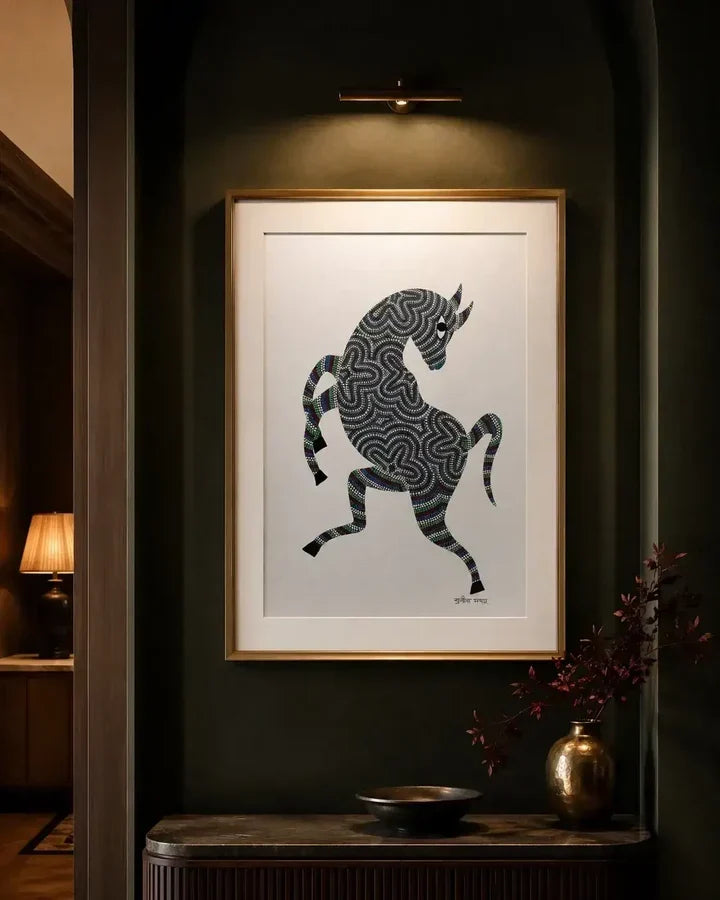
The repeated dots and patterns are among the most recognisable visual features associated with contemporary Bhil paintings.
However, it is important not to reduce every dot in every Bhil artwork to one fixed symbolic meaning.
Bhil art includes different regional and individual practices, and artists have developed their own ways of filling forms, creating patterns and building visual rhythm.
The dots can contribute to:
The best way to understand them is as part of the artist's visual language rather than assuming that every individual dot has a separate symbolic meaning.
How Is Traditional Bhil Painting Made?
Traditional Bhil painting practices have used locally available materials.
IGNCA documents Bhil communities in Madhya Pradesh using pigments extracted from leaves and flowers, with simple handmade brushes made from cloth or cotton attached to neem twigs.
Traditional wall painting practices also involved preparing and decorating household walls with locally available materials.
As Bhil artists moved into contemporary art spaces, paper, canvas, acrylics and other modern materials became part of the practice.
This means that traditional Bhil art and contemporary Bhil painting are not necessarily the same thing.
The material may change while themes, stories, motifs and cultural influences continue to evolve.
Is Bhil Art a Tribal Art Form?
Yes. Bhil painting is generally discussed as part of India's Adivasi and tribal art traditions.
However, the term “tribal art” should not make the artwork seem static or primitive. Bhil artists have continued to reinterpret their culture and experiences through changing materials and contemporary subjects.
For example, Bhuri Bai's work includes traditional themes such as animals, forests, trees, deities and Bhil life, while also incorporating modern subjects such as airplanes, television, cars and buses.
This shows that Bhil art can be both rooted in tradition and open to contemporary expression.
What Is the History of Bhil Painting?
The history of Bhil painting is closely connected with the everyday and ritual life of Bhil communities.
Traditional paintings were created on walls and floors of homes and temples. In Rajasthan, Bhil wall paintings included animals, birds, deities, flowers, people and scenes from local cultural traditions.
In Madhya Pradesh, Pithora painting is an important ritual tradition among Bhil communities of Jhabua. IGNCA describes Pithora wall paintings as depicting aspects of Bhil creation mythology and including the Sun, Moon, animals, trees, insects, rivers, fields and mythological figures.
During the 20th century, several Bhil artists began creating works on paper and canvas, helping these traditions enter museums, galleries and contemporary art spaces.
Who Are Some Famous Bhil Artists?
Several artists have played an important role in bringing Bhil art to wider audiences.
Bhuri Bai is one of the best-known contemporary Bhil artists. IGNCA documents her transition from traditional village painting practices to painting on paper and canvas. Her work incorporates forests, animals, trees, deities, festivals, homes and many aspects of Bhil life.
Phula Pargi is another important Bhil artist whose paintings are strongly connected with storytelling. His work includes animals, birds, deities and stories such as the Peacock and Indra narrative.
Artists such as Goma Pargi and Bhima Pargi also demonstrate the diversity of Bhil artistic expression, particularly through their depictions of animals, people, mountains, deities and cultural narratives.
How Can You Identify an Original Bhil Painting?
Identifying an original Bhil painting should involve more than looking at whether the artwork contains dots, animals or bright colours.
Consider:
1. Artist Information
A credible artwork should ideally provide information about the artist or artisan.
2. Medium
Find out whether the artwork is handmade on canvas, paper or another surface, or whether it is a printed reproduction.
3. Technique
Look closely at the patterns, lines, dots and details. Handmade artwork generally shows the individual decisions and variations of the artist.
4. Story and Cultural Context
Ask about the subject of the painting and the story or tradition behind it.
5. Provenance
For higher-value artworks, information about the artist, origin, documentation or provenance can add important authenticity context.
6. Avoid Assuming That One Style Defines All Bhil Art
Bhil communities and artists have diverse traditions. A painting should not automatically be considered inauthentic simply because it looks different from another Bhil artwork.
What Is the Difference Between Bhil Art and Gond Art?
Bhil and Gond are both important Adivasi art traditions from central and western parts of India, but they are not the same tradition.
They have different cultural histories, communities, stories, artists and visual practices.
Even within Bhil art itself, traditions can vary between regions. IGNCA specifically notes differences between Bhil communities of Madhya Pradesh and Rajasthan in their deities, songs, dances and stories.
Therefore, Bhil painting should be understood on its own terms rather than simply being treated as another version of Gond painting.
Why Should You Buy a Bhil Painting?
A Bhil painting can bring more than colour to a space.
It can introduce:
-
A connection with Indian Adivasi art
-
Nature-inspired storytelling
-
Traditional motifs
-
Handmade artistic expression
-
Cultural history
-
A distinctive visual language
When choosing a Bhil artwork, look beyond whether the painting “matches the wall.”
Ask:
Who created it?
What story does it tell?
What tradition does it represent?
Is it handmade or printed?
These questions help transform the purchase from simply buying wall décor into collecting a piece of Indian artistic heritage.
Frequently Asked Questions About Bhil Art
What is Bhil art?
Bhil art is an Adivasi art tradition associated with Bhil communities across parts of India. It includes paintings and visual traditions connected with nature, mythology, community life, rituals and storytelling.
What is Bhil painting?
Bhil painting refers to paintings created within Bhil artistic traditions, including traditional wall paintings and contemporary works created on paper and canvas.
Why are animals common in Bhil paintings?
Animals are closely connected with nature, everyday life, mythology and storytelling in Bhil culture, making them recurring subjects in Bhil paintings.
What does the peacock represent in Bhil art?
The peacock is a recurring motif in Bhil visual traditions and can also appear in cultural stories and narratives. Its specific meaning depends on the artwork and the story represented.
Why do Bhil paintings have dots?
Dots and repeated patterns are an important part of the visual language of many contemporary Bhil paintings. They create texture, rhythm, pattern and visual detail.
Is Bhil painting handmade?
Traditional Bhil painting practices were handmade, including wall painting using locally available pigments and simple tools. Contemporary Bhil artists may use paper, canvas, acrylics and other materials.
Where does Bhil art come from?
Bhil communities live across parts of Madhya Pradesh, Rajasthan, Gujarat and Maharashtra, and Bhil artistic traditions vary between regions.
Is Bhil art the same as Gond art?
No. Bhil and Gond are distinct Adivasi art traditions with their own communities, histories, artists and visual traditions.
How can I identify an original Bhil painting?
Look at the artist information, medium, handmade details, cultural context, provenance and whether the artwork is an original handmade piece or a printed reproduction.
Final Thoughts
Bhil art is much more than a colourful painting filled with dots.
It is a visual language shaped by nature, animals, birds, people, mythology, community traditions and storytelling.
From the peacock and animals to trees, rivers and everyday life, Bhil paintings can preserve stories and cultural memories while continuing to evolve through contemporary artists.
That is what makes Bhil art particularly meaningful for a modern art collector: it connects traditional Indian visual culture with a living, evolving artistic practice.
If you are looking for a Bhil painting for your home, take time to understand the artist, the story, the technique and the cultural background behind the artwork. The more you know about the painting, the more meaningful it becomes.


![[Product Title] - Avyaan](http://aavyaan.com/cdn/shop/files/Grace_of_Beginnings_Ganesha_in_Tanjore_Gold_800x800_5057dc37-751a-4085-b2c1-a1a947001f54.webp?v=1784792848&width={width})
![[Product Title] - Avyaan](http://aavyaan.com/cdn/shop/files/Mockup_Ganga_Avataran_1.png?v=1784793858&width={width})
![[Product Title] - Avyaan](http://aavyaan.com/cdn/shop/files/26.png?v=1784792915&width={width})
![[Product Title] - Avyaan](http://aavyaan.com/cdn/shop/files/Tanjore-radhakrishna-png_1.webp?v=1784792858&width={width})
![[Product Title] - Avyaan](http://aavyaan.com/cdn/shop/files/Mockup_3.2_1-1.png?v=1784794004&width={width})
![[Product Title] - Avyaan](http://aavyaan.com/cdn/shop/files/Radiance_of_Prosperity_Gaja_Lakshmi_in_Tanjore_Splendor_2.webp?v=1784792826&width={width})
![[Product Title] - Avyaan](http://aavyaan.com/cdn/shop/files/29.png?v=1784792820&width={width})