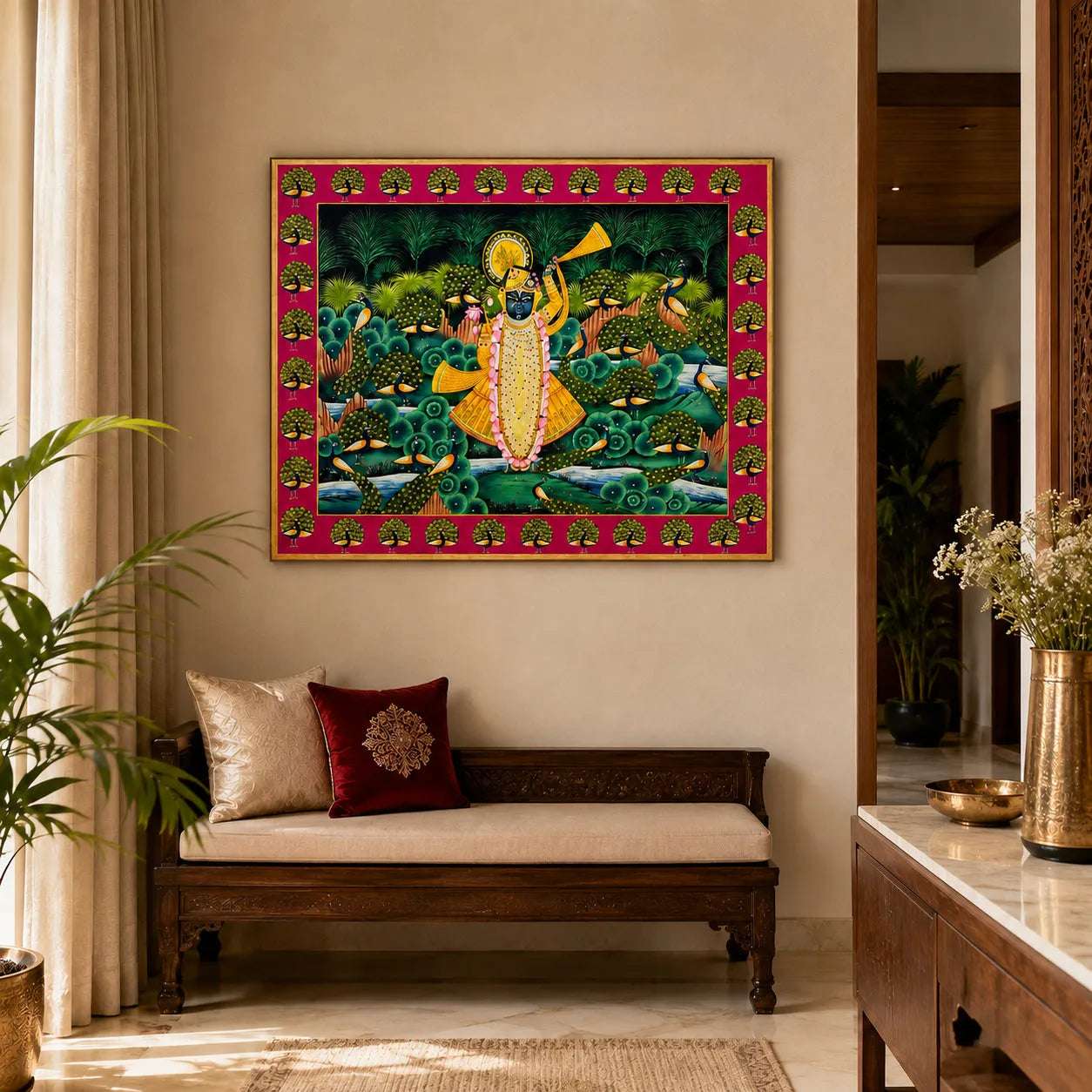
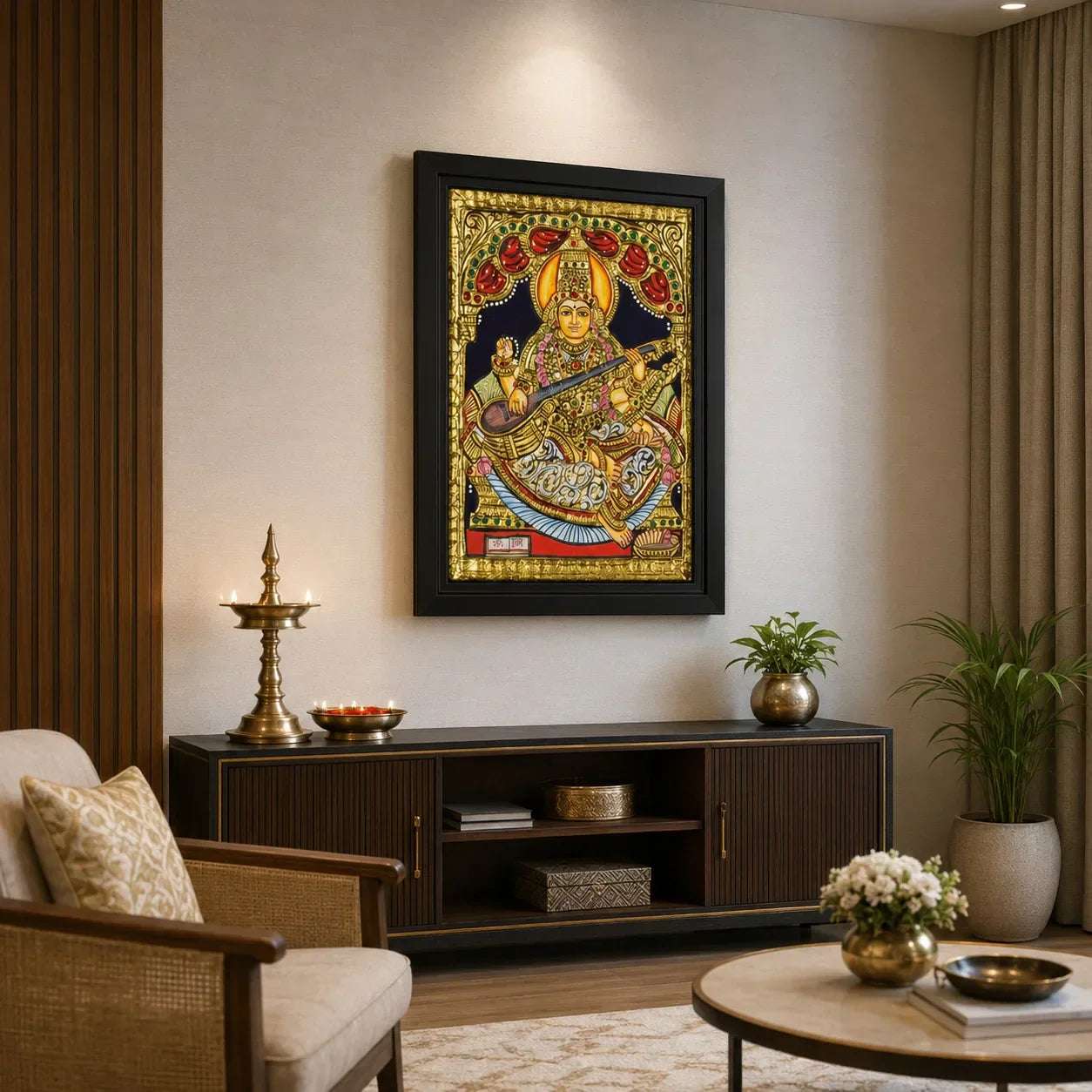
Walk into a home styled with old-world Rajasthani soul today, and there's a fair chance you'll find a Pichwai hanging behind the sofa or above a console table. What was once reserved for temple sanctums in Nathdwara is now finding its way into apartments in Bengaluru, penthouses in Mumbai, and living rooms across the Indian diaspora abroad. This isn't a passing decor fad. It's a return to something deeper — art that carries devotion, symbolism, and centuries of craft inside every brushstroke.
If you've been searching for traditional Pichwai art for living room spaces, this guide walks you through why these paintings work so well in contemporary interiors, what the recurring motifs actually mean, and how to bring home a piece that's genuinely handcrafted rather than a printed imitation.
What Is Pichwai Art, Really?
Pichwai paintings originated in Nathdwara, Rajasthan, as large cloth backdrops hung behind the idol of Shrinathji, a child form of Lord Krishna. The word itself comes from "pichh" (behind) and "wai" (hanging) — literally, "that which hangs behind." Traditionally, these were changed according to the season, festival, or time of day, each one telling a different chapter of Krishna's life through color, gesture, and symbol.
What makes Pichwai different from decorative art is intent. Every element placed on the canvas is a form of worship, not decoration for its own sake. That's precisely why a hand-painted Pichwai feels different in a room than any generic wall art — it holds a narrative and a devotional weight that mass-produced prints simply cannot replicate.
The Spiritual Language Hidden in Every Pichwai
The Cow: Devotion, Abundance, and Krishna's Childhood
No motif appears as consistently in Pichwai art as the cow, and it's rarely just decorative. In Vaishnav tradition, Krishna is Gopal — the protector and keeper of cows — and his childhood in Vrindavan was spent among cowherds. The cow represents Kamadhenu-like abundance, maternal nourishment, and the simplicity of rural devotion that Krishna himself embodied.
This is where the search for Pichwai cow and lotus painting meaning usually begins. A cow in a Pichwai isn't a farm animal rendered for realism — it's a stand-in for gentleness, sustenance, and the idea that divinity dwells in the everyday and the pastoral, not only in grand temples. Artists often paint cows in soft, rounded forms with calm, half-closed eyes, deliberately evoking serenity rather than motion.
The Lotus: Purity Rising Above the Mundane
The lotus is the second pillar of Pichwai symbolism, and its meaning is almost the opposite of decorative prettiness. A lotus grows rooted in mud yet opens into a flawless, unstained bloom above the water's surface. In Hindu philosophy, this is a metaphor for the soul's ability to remain untouched by the material world even while living within it.
In Pichwai compositions, lotuses often frame Krishna's feet, form thrones for the divine figure, or fill ponds where cows drink and gopis gather. Every petal, usually painted with a fine single-hair brush, is a meditative act in itself — repetition as devotion. This is also why so many buyers today, drawn to the Pichwai cow and lotus painting meaning, choose these pieces specifically for meditation rooms, poojas corners, or reading nooks where they want a visual anchor for calm.
Peacocks, Trees, and the Circle of Vrindavan
Beyond cows and lotuses, Pichwai paintings are dense with symbolic life: peacocks representing grace and the monsoon season Krishna loved, kadamba trees marking the forests of Vrindavan, gopis in swirling ghagras representing collective devotion (bhakti), and the moon or sun motifs marking time and cosmic order. Even the color palette is intentional — deep reds for passion and festivity, yellows for auspiciousness, and blues echoing Krishna's own complexion.
Understanding these layers changes how you experience the art. It stops being "a nice painting" and becomes a visual scripture you can read every time you walk past it.
Why Pichwai Works So Well in Modern Interiors
Modern homes, especially in India, are increasingly moving away from stark minimalism toward what designers now call "warm minimalism" — clean lines paired with one or two pieces of deep cultural weight. Pichwai fits this shift almost perfectly for a few reasons:
The color depth anchors a neutral room. A single large Pichwai in deep teal, maroon, or gold instantly grounds an otherwise beige or white living room without requiring you to repaint a single wall.
The symmetry is inherently calming. Most Pichwai compositions are built around central symmetry — Krishna or Shrinathji in the middle, mirrored elements on either side. This visual balance works with almost any furniture layout, from a minimalist sofa setup to a more maximalist, layered living room.
It scales beautifully. A large Pichwai panel makes a striking statement piece above a console or bed. Smaller studies of a single motif, such as a cow-and-lotus composition, work well as a pair flanking a doorway or as a focal point in a home office or study.
Styling Ideas for Different Spaces
-
Living rooms: Hang a large Pichwai as the visual center behind the main seating, ideally with warm ambient lighting rather than direct spotlighting, which can wash out the fine detailing.
-
Meditation or pooja corners: A smaller cow-and-lotus study, given its calming symbolism, works better here than a large, busier composition.
-
Entryways and hallways: Vertical Pichwai panels featuring a single tree or peacock motif create an elegant, uncluttered welcome.
-
Bedrooms: Softer palettes — cream, dusty rose, sage — pair well with muted Pichwai work above the headboard for a serene, non-overpowering statement.
How to Tell an Authentic Pichwai From a Print
This matters more than most buyers realize. A genuine, hand-painted Pichwai involves natural pigments, fine detailing done with single-hair brushes, and hours (sometimes weeks) of an artisan's labor. A printed reproduction, however well done, will have flat color fields, mechanically uniform lines, and no texture variation when viewed closely.
If you're planning to buy authentic Pichwai art online, a few checks help:
- Look for slight, natural irregularities in line work — true handwork is never perfectly uniform, and that's part of its value.
- Ask the seller which artisan cluster or region the piece comes from. Authentic pieces usually carry a documented lineage back to Nathdwara or nearby GI-recognized clusters.
- Check whether the seller discloses the medium — natural stone colors and cloth versus synthetic paint on canvas changes both the price and the longevity of the piece.
- Be wary of listings that don't mention the artisan at all. Authentic craft brands are generally proud to name the hands behind the work.
A Living Tradition, Not a Museum Piece
The reason Pichwai has found new life in modern homes isn't nostalgia. It's that these paintings do something rare in interior design — they hold meaning even when you're not actively thinking about it. A cow grazing beside a lotus pond isn't just visually pleasing; it's a quiet daily reminder of abundance, purity, and devotion, sitting on your wall long after the initial "this looks beautiful" moment fades.
If you're building a home that reflects both aesthetic sensibility and cultural depth, an authentic, hand-painted Pichwai isn't just decor. It's a small, ongoing conversation with a 400-year-old tradition — one that happens to also look extraordinary above your sofa.
Where to Place Cow and Lotus Pichwai Painting at Home for Vastu Benefits?
If you want to bring absolute peace, financial growth, and positive energy to your space, understanding the Cow Pichwai Painting Vastu benefits is essential. According to Vastu Shastra, a Kamdhenu Cow Pichwai painting wall placement should ideally be on the East or North-East wall of your living room or home temple. This direction invokes divine blessings and prosperity. Additionally, hanging a Lotus Pichwai Painting for wealth and peace in the North direction helps attract new opportunities and financial abundance, making it a perfect addition to modern homes.


![[Product Title] - Avyaan](http://aavyaan.com/cdn/shop/files/Grace_of_Beginnings_Ganesha_in_Tanjore_Gold_800x800_5057dc37-751a-4085-b2c1-a1a947001f54.webp?v=1784792848&width={width})
![[Product Title] - Avyaan](http://aavyaan.com/cdn/shop/files/Mockup_Ganga_Avataran_1.png?v=1784793858&width={width})
![[Product Title] - Avyaan](http://aavyaan.com/cdn/shop/files/26.png?v=1784792915&width={width})
![[Product Title] - Avyaan](http://aavyaan.com/cdn/shop/files/Tanjore-radhakrishna-png_1.webp?v=1784792858&width={width})
![[Product Title] - Avyaan](http://aavyaan.com/cdn/shop/files/Mockup_3.2_1-1.png?v=1784794004&width={width})
![[Product Title] - Avyaan](http://aavyaan.com/cdn/shop/files/Radiance_of_Prosperity_Gaja_Lakshmi_in_Tanjore_Splendor_2.webp?v=1784792826&width={width})
![[Product Title] - Avyaan](http://aavyaan.com/cdn/shop/files/29.png?v=1784792820&width={width})