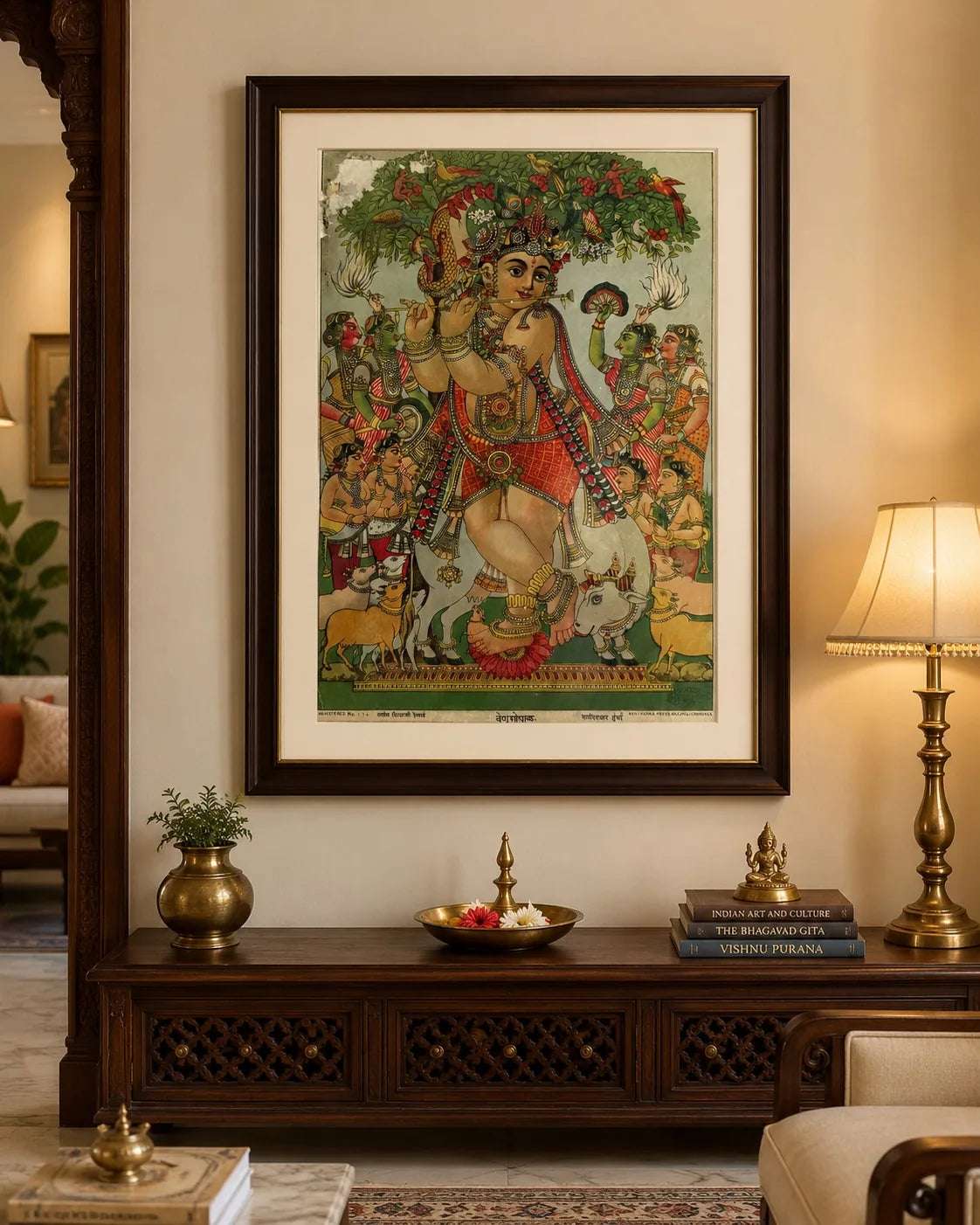
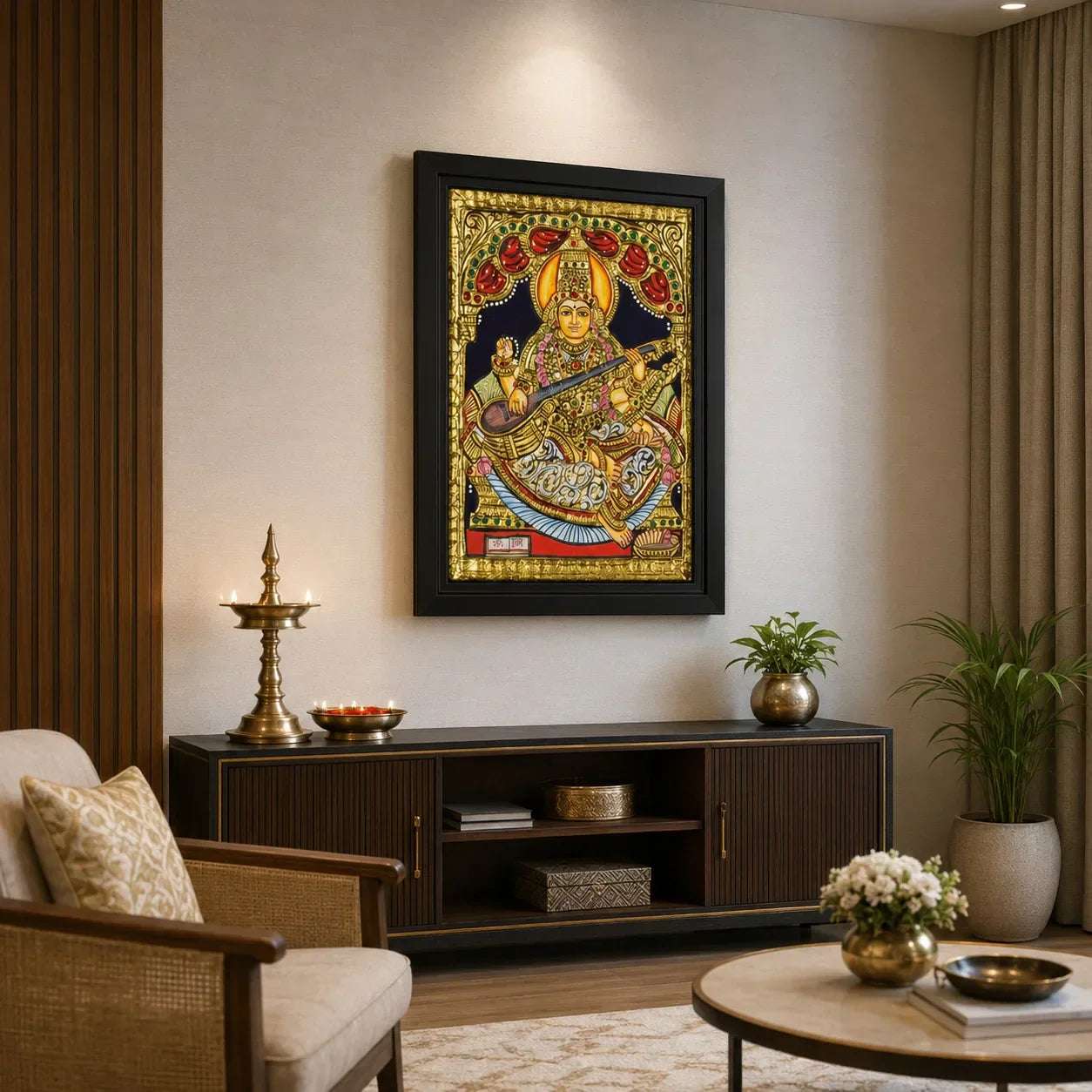
In 1894, a man in Bombay did something that had never been done in India before. He took a painting of the goddess Saraswati — a piece that, by every rule of the art world at the time, should have belonged to exactly one wealthy collector — and made it possible for a farmer in Karnataka, a schoolteacher in Bengal, and a shopkeeper in Punjab to each hang the same image in their homes, all in the same year.
That man was Raja Ravi Varma. The technique he used was oleography. And more than a century later, the surviving originals from that first print run are some of the most quietly significant objects in Indian art history — not because of what they depict, but because of what they represent: the exact moment Indian mythology stopped belonging only to temples and palaces, and started belonging to everyone.
This is the real story of the oleograph — what it is, how it was made, and why the surviving pieces matter far more than most people realize.
So What Exactly Is an Oleograph?
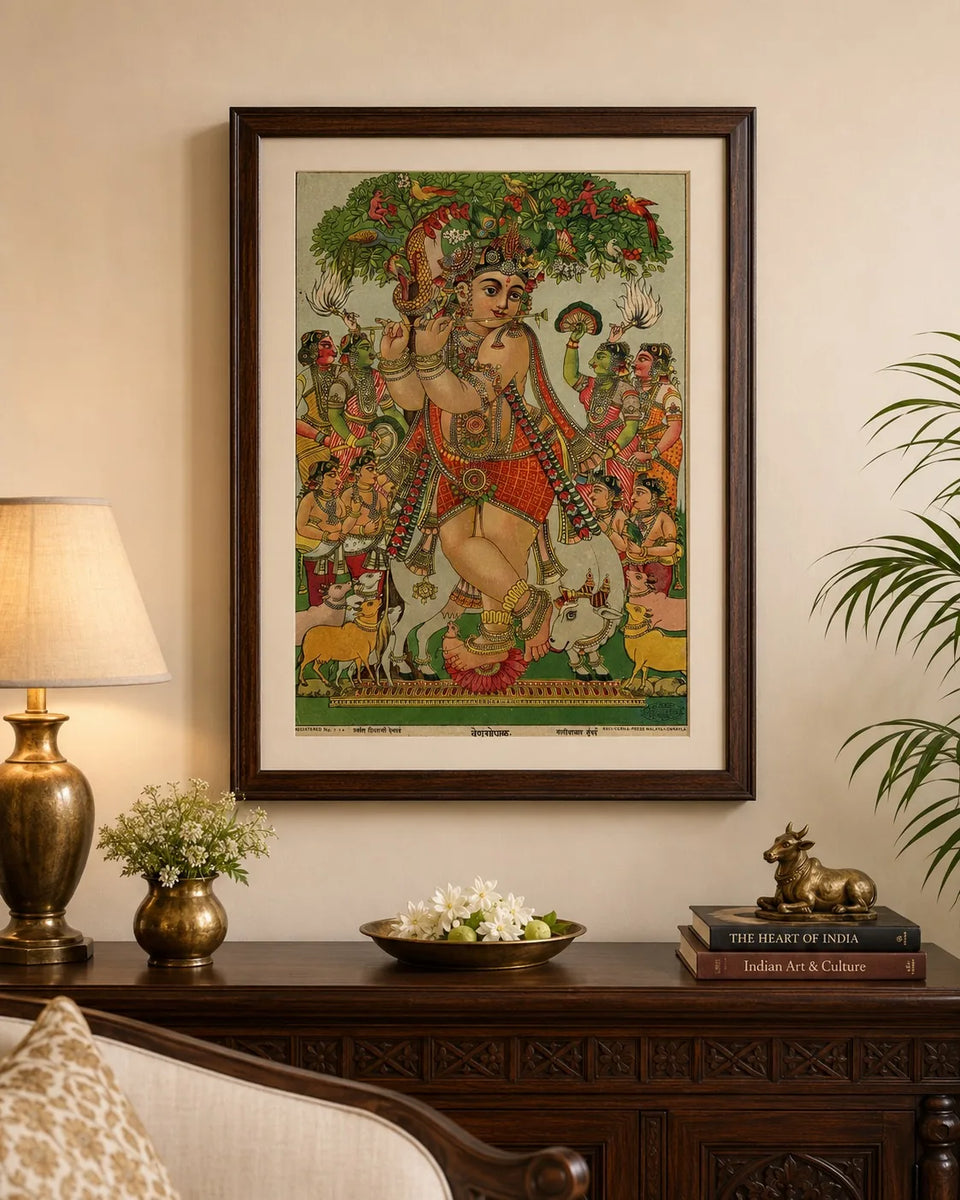
Here's the part that surprises most people: an oleograph isn't a painting at all. It's a print. But it's a print built to trick your eye into thinking it's a painting.
The word comes from the Latin oleum, meaning oil — a direct reference to what the process was trying to imitate. Oleography uses chromolithography: a separate hand-carved stone block for every single color in the image, each one inked and pressed onto paper or canvas in careful sequence, one layer at a time. A single complex image might require a dozen or more stones, each one perfectly aligned with the last.
Get it right, and the result doesn't look printed at all. The colors sit with the depth of oil paint. The gradients look brushed, not mechanical. Stand a few feet back, and an oleograph can pass for the original it was copying. That illusion was the entire point — and it's why, even today, a genuine period oleograph is often mistaken for a hand-painted work by people who don't know what they're looking at.
The technique itself was invented in England — the printer George Baxter developed it in the 1830s, and by the 1860s it had become a common way to mass-produce everything from packaging labels to European calendar art. It was, frankly, a commercial technique before it was ever an artistic one. What changed everything was what happened when it reached India — and what one artist decided to do with it.
The Diwan's Idea, and the Decade It Took to Act On It
The idea wasn't originally Ravi Varma's. In 1884, T. Madhava Rao, the Diwan of Travancore, made a suggestion to the already-famous painter: send your work to be reproduced as prints, so it can reach people who could never commission an original.
It's worth sitting with how radical that idea was at the time. Ravi Varma was already the most sought-after painter of Indian mythological and royal subjects — the kind of artist whose commissions came from maharajas. The Diwan was essentially asking him to give up exclusivity, the very thing that made his work valuable to the elite, in exchange for reach.
Ravi Varma didn't act immediately. It took nearly eight years. In 1892, he finally imported steam-driven lithographic machinery from Germany and brought in two German technicians — Fritz Schleicher and B. Gerhardt — to install and run it. Two years later, in July 1894, the Ravi Varma Fine Art Lithographic Press in Girgaum, Bombay, produced its first print: The Birth of Shakuntala. Lakshmi and Saraswati followed soon after.
At full operation, the press could turn out close to eight hundred impressions an hour. Within a few years, Ravi Varma's gods and goddesses weren't just paintings anymore — they were the default visual language for how an entire subcontinent pictured its own mythology. That's the part that's easy to miss: before this press existed, there was no single widely agreed-upon "look" for Lakshmi, or Krishna, or Saraswati. Ravi Varma's oleographs effectively wrote the visual grammar that Indian religious art still uses today.
What Actually Happened to the Press (Not the Fire Story You've Heard)
If you've read about oleographs online, you've probably come across a tidy explanation for why originals are rare: "the printing stones were destroyed in a fire, so no new prints can ever be made." It's a clean story. It's also not quite what happened.
The real sequence is messier, and more interesting. Financial strain led Ravi Varma to sell the press to Schleicher, his own German technician. Under new ownership, the operation didn't stay put — it relocated more than once, moving from Girgaum to Ghatkopar, and eventually to Malavli near Lonavala, where it operated for decades under a succession of names: the F.A.L. Press, the Ravi Varma Press Karla, the Ravi Uday Press, later the Malavli Press. It kept printing — not just Ravi Varma's own paintings, but work by other artists like M.V. Dhurandhar — well after Ravi Varma's death in 1906, continuing in some form all the way into the 1980s.
So what makes an early oleograph genuinely rare isn't fire. It's time and ownership. The specific prints made under Ravi Varma's direct supervision, at the original Bombay press, in that narrow 1894–1901 window, represent a closed chapter that ended when the press changed hands — not because the physical materials vanished, but because that particular creative moment did. It's a rarer, truer, and frankly more compelling story than "everything burned down."
How to Actually Read an Oleograph Before You Trust It
If you're evaluating a piece, the image itself is the least reliable clue. What actually tells you something:
-
The press inscription along the border. Bombay, Ghatkopar, Karla, and Malavli imprints each mark a different era of the press's life — and they date the piece far more precisely than the subject matter does.
-
The paper or canvas itself. Genuine period paper ages in ways that are difficult to fake convincingly — foxing, toning, and fiber composition all leave honest evidence of time.
-
Slight imperfections in color registration. Real stone-lithograph printing almost never aligns its color layers with perfect, mechanical precision. Ironically, that tiny imperfection is often the strongest sign of authenticity.
-
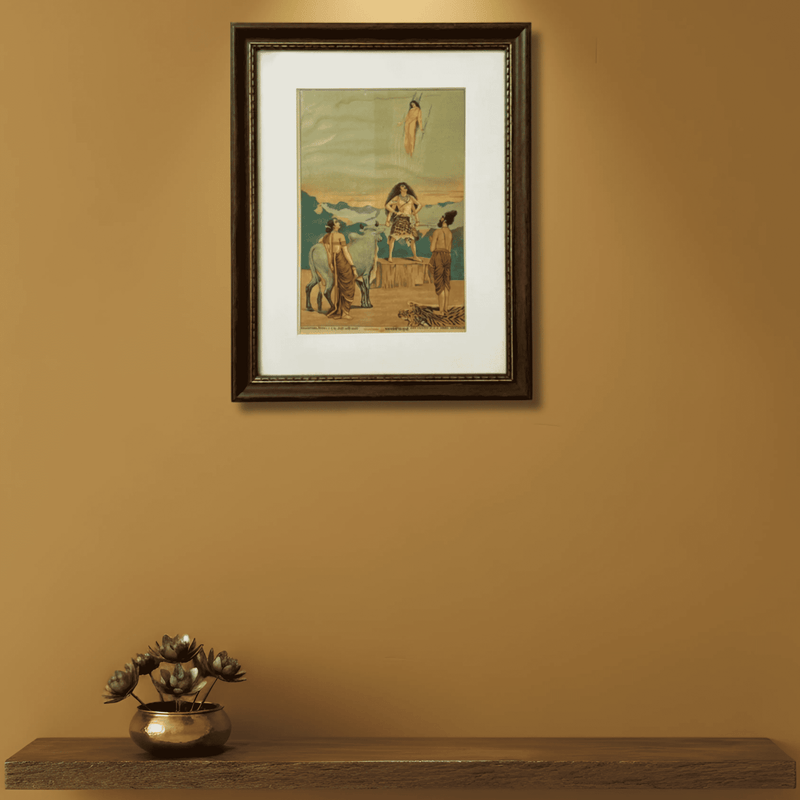
How rare the subject is. Some compositions were printed in far smaller runs than the widely reproduced Lakshmi and Saraswati images — Ganga Avataran is a good example of a subject with a much thinner surviving trail.
Why This History Still Matters in a Modern Living Room
It's easy to treat an oleograph as decor. But there's a stronger way to think about it: these prints were, quite possibly, India's first mass art movement — arriving decades before newspapers had photographs, let alone before anyone imagined a shared visual mythology could exist across an entire subcontinent.
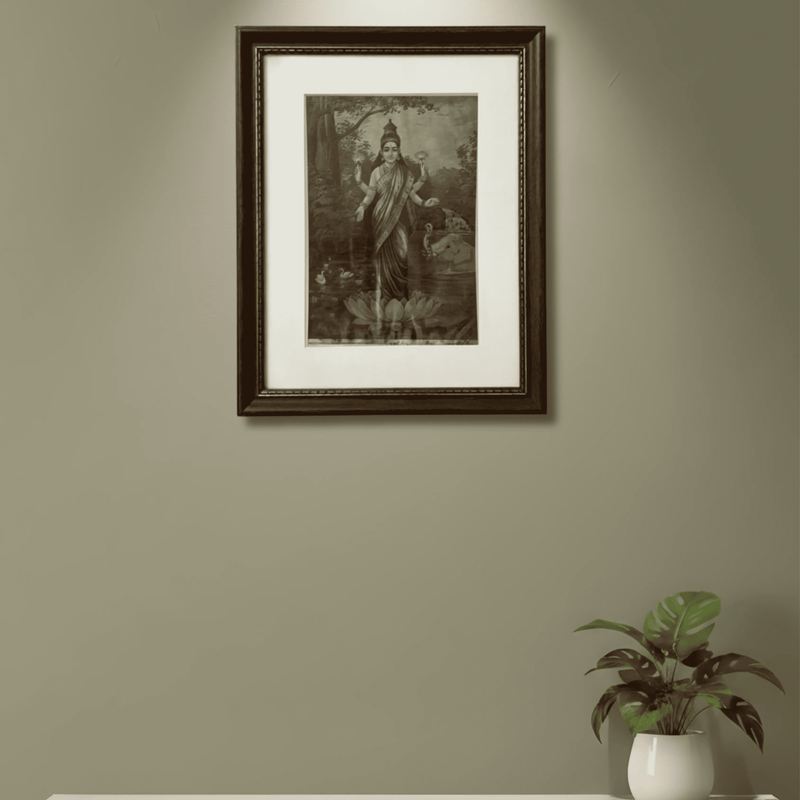
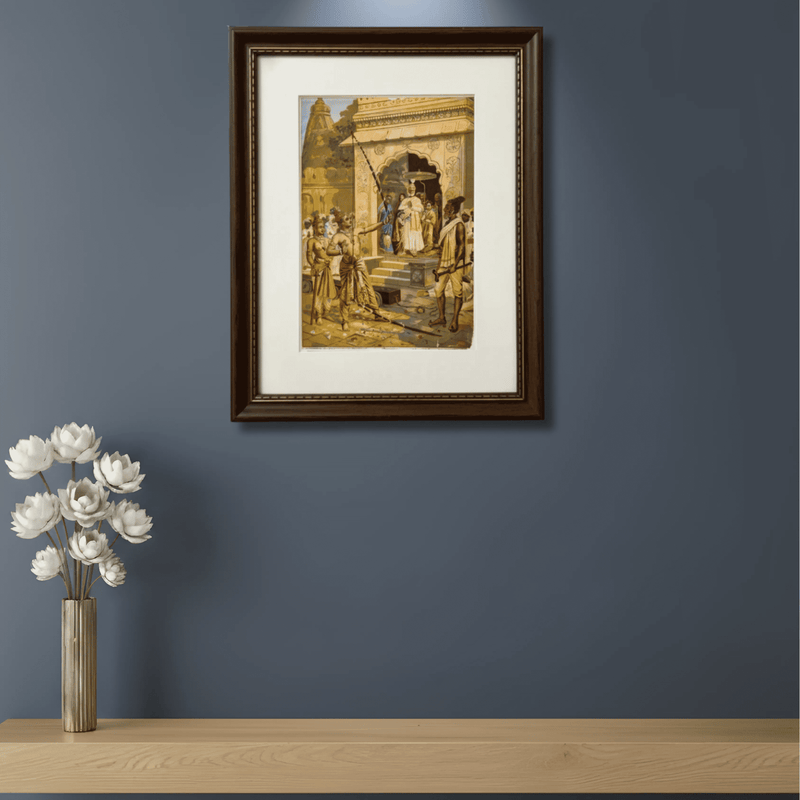
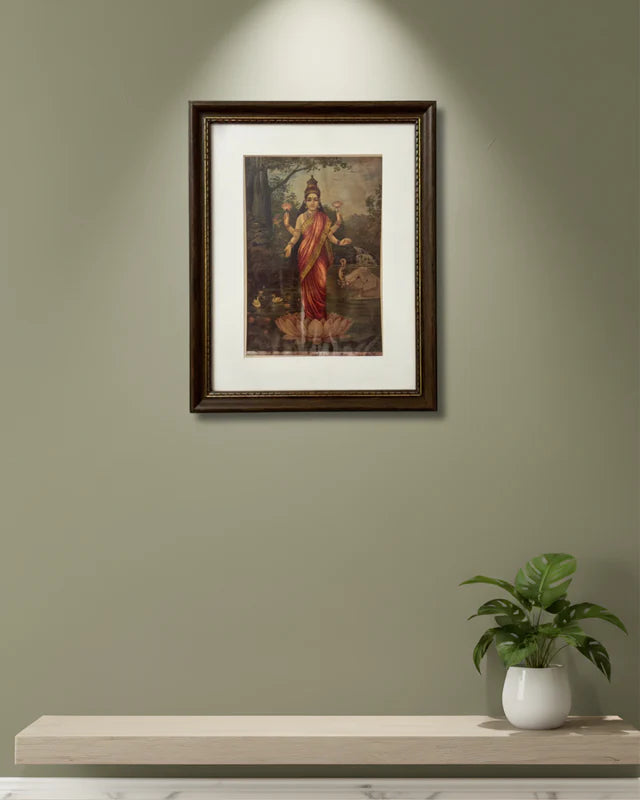
That's the thread we've followed at Avyaan, and it's why our Raja Ravi Varma Oleographs collection exists the way it does — sourced directly from vetted private collectors, with attention to press marks, paper condition, and provenance, rather than treating these pieces as generic "vintage religious prints." Subjects like Goddess Lakshmi and Vishnu with Sridevi and Bhudevi sit within that same broader mission we bring to Pichwai, Tanjore, and Patola work — keeping GI-tagged and heritage Indian art forms alive and visible, not filed away as museum curiosities.
If You Already Own One
A few habits protect an oleograph across decades, not just years:
- Keep it out of direct sunlight — both the oil-based ink and the paper base are light-sensitive, and fading is permanent, not reversible.
- Use UV-protective glass and acid-free matting when framing, so the paper isn't slowly damaged by contact with the frame itself.
- Control humidity swings more than temperature — paper this old suffers more from damp-to-dry cycling than from heat.
- Resist the urge to clean or restore it yourself. A paper conservator who has actually handled lithographic prints is worth finding before you touch anything.
The next time you spot one of these prints — in a grandparent's house, at an estate sale, tucked in a corner of an antique shop — you're not looking at "old calendar art." You're looking at the first time an entire country agreed, together, on what its gods looked like. That's a bigger claim than most decor has any right to make.
Raja Ravi Varma Oleographs & Meaning FAQ
What is an oleograph painting and its meaning?
An oleograph is a specialized multi-color print produced via a lithographic process using oil-based inks on stone or zinc plates. The true oleograph meaning lies in its technique: oil inks are layered onto heavy paper or canvas to perfectly mimic the texture, surface sheen, and color depth of an original fine art oil painting.
What determines a Raja Ravi Varma oleograph price and value?
An authentic late 19th or early 20th-century Raja Ravi Varma oleograph price generally ranges from INR 25,000 to INR 3,00,000+ depending on physical condition and market demand. The antique oleograph painting value is determined by paper integrity, the signature lithographic press stamp (such as Ravi Varma Fine Arts Press), and the overall rarity of the published subject.
Can you find rare prints like Ganga Avataran and Durga at Aavyaan?
Yes, iconic masterworks such as Ganga Avataran by Raja Ravi Varma and Ravi Varma Durga are highly sought-after collector pieces curatively sourced by Aavyaan. Because the original lithographic stones were historically destroyed in press fires, these specific prints represent a strictly finite supply, making them highly collectible heritage assets.


![[Product Title] - Avyaan](http://aavyaan.com/cdn/shop/files/Grace_of_Beginnings_Ganesha_in_Tanjore_Gold_800x800_5057dc37-751a-4085-b2c1-a1a947001f54.webp?v=1784792848&width={width})
![[Product Title] - Avyaan](http://aavyaan.com/cdn/shop/files/Mockup_Ganga_Avataran_1.png?v=1784793858&width={width})
![[Product Title] - Avyaan](http://aavyaan.com/cdn/shop/files/26.png?v=1784792915&width={width})
![[Product Title] - Avyaan](http://aavyaan.com/cdn/shop/files/Tanjore-radhakrishna-png_1.webp?v=1784792858&width={width})
![[Product Title] - Avyaan](http://aavyaan.com/cdn/shop/files/Mockup_3.2_1-1.png?v=1784794004&width={width})
![[Product Title] - Avyaan](http://aavyaan.com/cdn/shop/files/Radiance_of_Prosperity_Gaja_Lakshmi_in_Tanjore_Splendor_2.webp?v=1784792826&width={width})
![[Product Title] - Avyaan](http://aavyaan.com/cdn/shop/files/29.png?v=1784792820&width={width})