By Avyaan | Craft Process | 6 min read

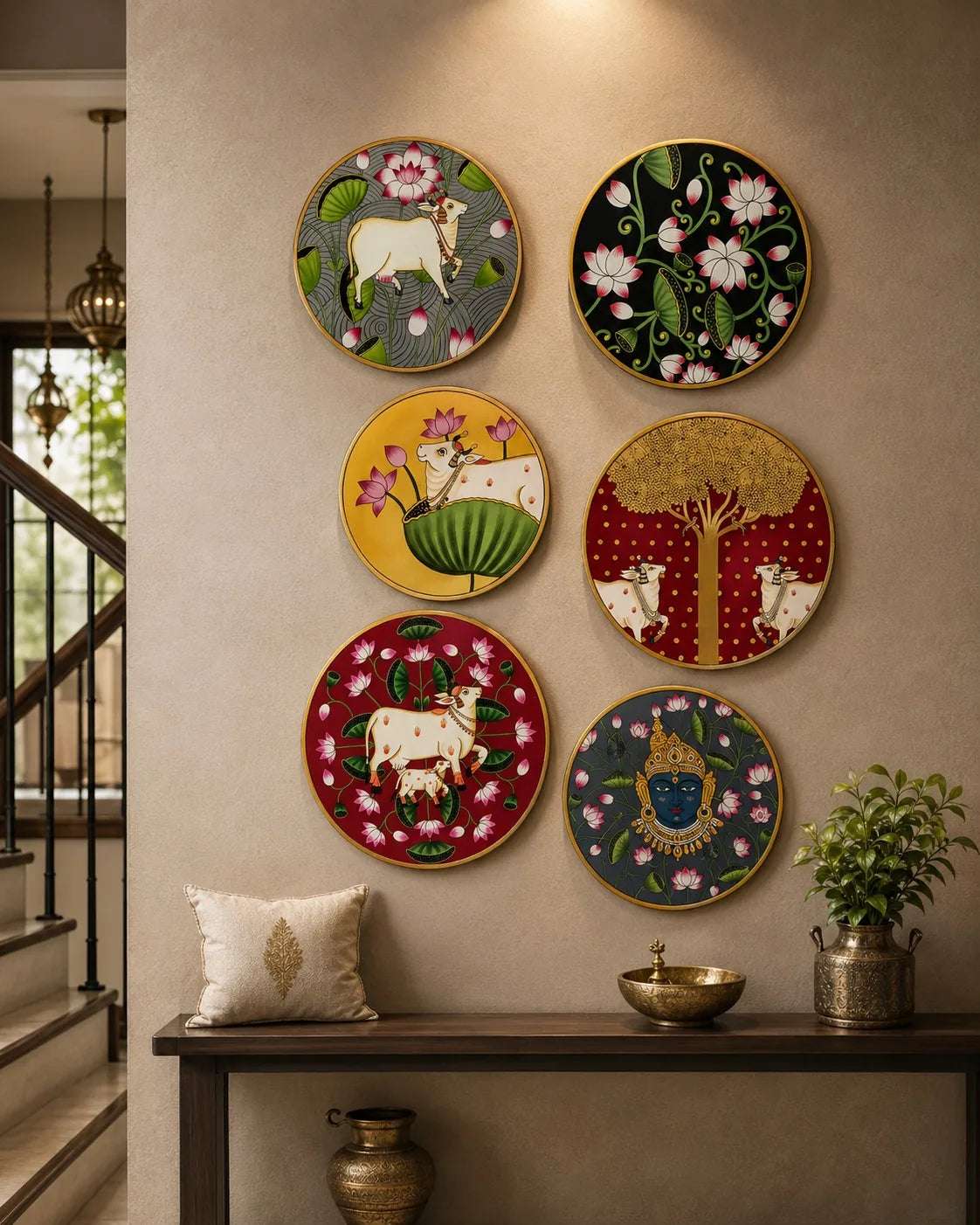
Most crafts travel poorly between materials. Embroidery patterns that work beautifully on cloth look clumsy translated to stone. Architectural details that make sense in metal become awkward in wood. This is why it is genuinely remarkable that Pichwai painting — a tradition developed specifically for cloth — has translated so successfully to ceramic.
The reason is partly the adaptability of the Pichwai visual language itself, and partly the skill of the craftspeople who have made the translation. This piece is about the process — how it actually works.
The Ceramic Base
Pichwai plates use a high-fired ceramic base — typically stoneware or fine earthenware — that has been bisque-fired (a first firing to harden the clay without glazing) before any painting begins. The surface at this stage is white or off-white, slightly porous, and ready to receive colour.
The quality of the base matters significantly. A plate made from inferior clay will warp slightly in firing, disrupting the painted composition. The best Pichwai plate makers use bases that have been thrown or moulded to exacting standards — consistently round, consistently flat, with walls of uniform thickness that will not distort under the heat of the second firing.
Adapting the Composition for a Curved Surface
This is where the real skill lies. In cloth Pichwai, the artist is working on a flat surface — every line is a line, every circle is a circle. On a plate, the centre of the composition is slightly lower than the rim, and the whole surface curves away from the viewer.
Experienced Pichwai plate painters have internalised how to account for this. They know, for instance, that horizontal lines near the rim of a plate will appear to curve downward when the plate is hung on a wall, so they must be painted with a compensating upward curve. They know that the face of Shrinathji at the centre of a plate will be seen at a slightly different angle than the border motifs, and they adjust the scale of each element accordingly.

Pigments and Gold
Traditional Pichwai uses natural mineral pigments on cloth. On ceramic, the equivalent materials are ceramic underglazes — oxides and minerals that are formulated to be stable under the high temperatures of kiln firing. These are not acrylic paints applied after glazing; they are fired into the ceramic surface and become a permanent part of the plate.
Gold detailing on Pichwai plates is typically applied as gold lustre — a metallic compound that is painted over a transparent glaze and then fired at a lower temperature in a third firing. The result is a genuine metallic gold finish that will not flake or tarnish. In the finest Pichwai plates, real gold lustre (containing actual gold content) is used; in more affordable versions, gold-coloured metallic lustres are substituted.
The Firing Process
Most Pichwai plates undergo at least two firings: a bisque firing to harden the clay, and a glaze firing to seal the painted decoration under a protective transparent glaze. Plates with gold detailing require a third firing at a lower temperature specifically for the metallic lustre.
Each firing carries risk. The kiln temperature, the placement of the pieces, the cooling rate — all of these affect the final outcome. Some colour shifts occur predictably during firing and experienced painters account for them; others are genuine surprises. This is why ceramics, unlike cloth painting, involves an element of collaboration between the artist and the kiln.
What Makes One Pichwai Plate Better Than Another
-
Composition quality: Is the Pichwai scene well-balanced? Are the figures in correct proportion? Does the design feel considered or cramped?
-
Fineness of brushwork: At close range, are the lines steady? Are the faces rendered with care? Is the gold work applied evenly?
-
Ceramic quality: Is the plate warped? Are there visible bubbles or cracks in the glaze? Is the surface smooth to the touch?
-
Gold quality: Is the gold metallic and reflective, or flat and dull? Does it show brush marks or is it smooth?
-
Durability of glazing: When you run your finger over the surface, does the paint feel protected and integrated, or slightly raised and vulnerable?
A plate that scores well on all five dimensions is a genuine craft object — something that will last for decades and improve in appearance as the gold softens with age.
See authenticated Pichwai plates with full craft documentation at https://aavyaan.com/


![[Product Title] - Avyaan](http://aavyaan.com/cdn/shop/files/Grace_of_Beginnings_Ganesha_in_Tanjore_Gold_800x800_5057dc37-751a-4085-b2c1-a1a947001f54.webp?v=1784792848&width={width})
![[Product Title] - Avyaan](http://aavyaan.com/cdn/shop/files/Mockup_Ganga_Avataran_1.png?v=1784793858&width={width})
![[Product Title] - Avyaan](http://aavyaan.com/cdn/shop/files/26.png?v=1784792915&width={width})
![[Product Title] - Avyaan](http://aavyaan.com/cdn/shop/files/Tanjore-radhakrishna-png_1.webp?v=1784792858&width={width})
![[Product Title] - Avyaan](http://aavyaan.com/cdn/shop/files/Mockup_3.2_1-1.png?v=1784794004&width={width})
![[Product Title] - Avyaan](http://aavyaan.com/cdn/shop/files/Radiance_of_Prosperity_Gaja_Lakshmi_in_Tanjore_Splendor_2.webp?v=1784792826&width={width})
![[Product Title] - Avyaan](http://aavyaan.com/cdn/shop/files/29.png?v=1784792820&width={width})