Cart
0
You may also like





By Avyaan | Heritage & History | 7 min read

The Persian ambassador at Akbar's court had seen the blue-tiled domes of Isfahan and Samarkand. The Mughal princes had spent their formative years among the turquoise-glazed mosques of Herat and Bukhara. The aesthetic of cobalt blue on white, fired to a glassy finish, was the prestige visual language of the Islamic world — and when it arrived in India, it found both a receptive royal audience and a population of craftsmen skilled enough to learn and adapt it.
But the story of how a Persian craft tradition became "Jaipur Blue Pottery" — distinct enough to be recognised internationally as a specifically Rajasthani product — is more complex than simple transplantation.
The technique that eventually became Jaipur blue pottery is known in its earlier Indian form as kashi work or neelan. It arrived in India with the Mughal emperors and their Persian-trained court craftsmen in the early 16th century.
In the Mughal period, the primary application was architectural: the extraordinary tilework that covers mosques, tombs, and garden pavilions across North India — from Humayun's Tomb in Delhi to the tilework of Lahore. These tiles were made using a variation of the same technique: a quartz-based body, cobalt blue and other coloured glazes, a transparent overglaze.

The story of how the craft concentrated in Jaipur involves specific historical circumstances. Sawai Ram Singh II, the Maharaja of Jaipur from 1835 to 1880, was a significant patron of local crafts and an advocate for their modernisation and export. He sponsored craftsmen, created workshops, and actively encouraged the production of blue pottery objects for domestic use and export.
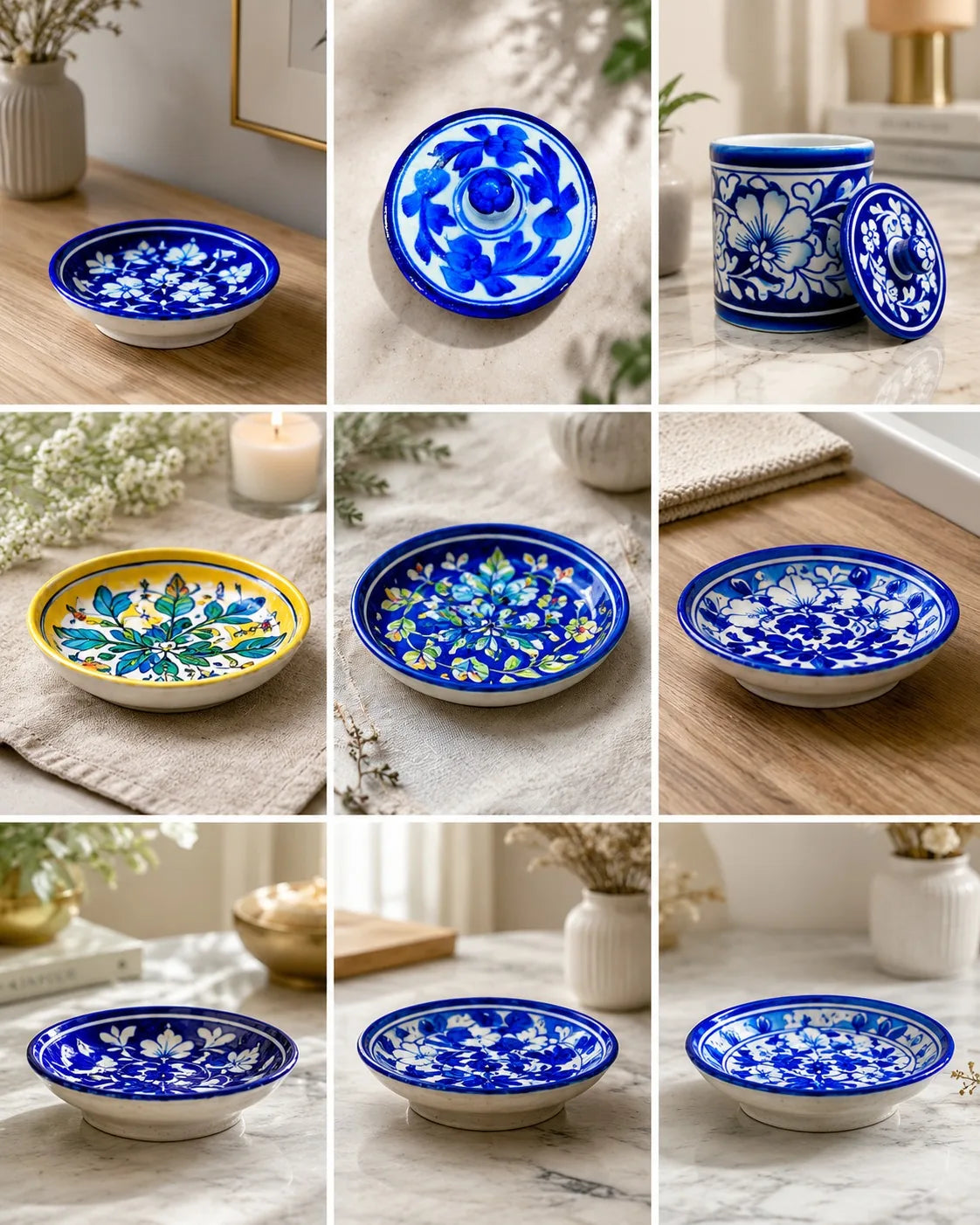
Under his patronage, Jaipur's blue pottery developed distinctly from the older kashi tradition. The focus shifted from architectural tilework to domestic objects — plates, vases, bowls, tiles for interiors — and the decorative language became more specifically Rajasthani: peacocks, flowers from Rajasthani embroidery traditions, geometric patterns from Jaipur architecture.
By the mid-20th century, Jaipur blue pottery was in serious decline. Demand had collapsed, master craftsmen were ageing without successors, and the traditional knowledge of the quartz body formula was held by very few people. The craft came close to disappearing entirely.
The revival is credited substantially to one person: Krishna Kumari, known as Kripal Singh Shekhawat, a Jaipur artist who took it upon himself to document the surviving techniques, train new practitioners, and find new markets for the craft. The Ford Foundation funded his revival efforts in the 1970s, and Kripal Singh went on to win national recognition including the Padma Shri.

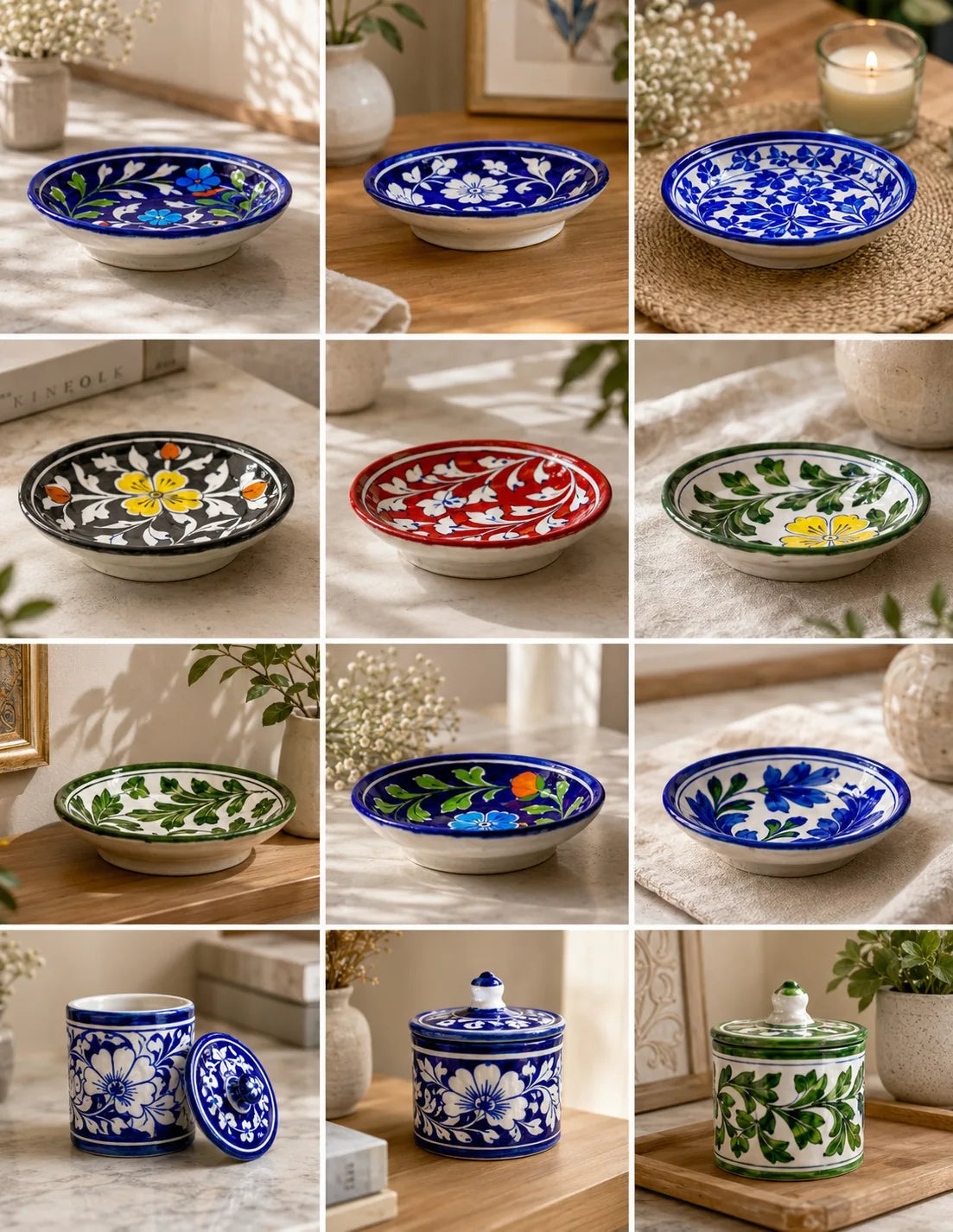
Today, Jaipur blue pottery is made by hundreds of practitioners in and around Jaipur, exported to markets around the world, and recognised with a GI (Geographical Indication) tag that legally protects its name and origin. Contemporary blue pottery incorporates traditional and new motifs, experiments with form, and sometimes collaborates with international designers who bring new aesthetic perspectives to the old technique.
The craft that nearly vanished fifty years ago is now one of Jaipur's most internationally recognised exports. It took one dedicated person's refusal to let it die — and decades of patient work to rebuild.
Authentic Jaipur blue pottery, crafted by trained artisans, at https://aavyaan.com/
Loading Mark360 Popup...

