The Uncomfortable Truth About the Tanjore Market Right Now
Most people buying a Tanjore painting today have never seen a real one up close. They're comparing a listing photo against another listing photo. That's the entire market failure that lets fakes thrive — the fraud doesn't happen at the point of sale, it happens at the point of photography, where gold paint photographs identically to gold foil and printed texture photographs identically to hand-embossed muck work.
So before the five tests, the one rule that matters more than all of them combined: never buy a Tanjore painting you can't touch, or that doesn't come from a seller willing to show you the back of the board. Everything below is what you check once you have that access — or what you ask a seller to video for you if you're buying online.
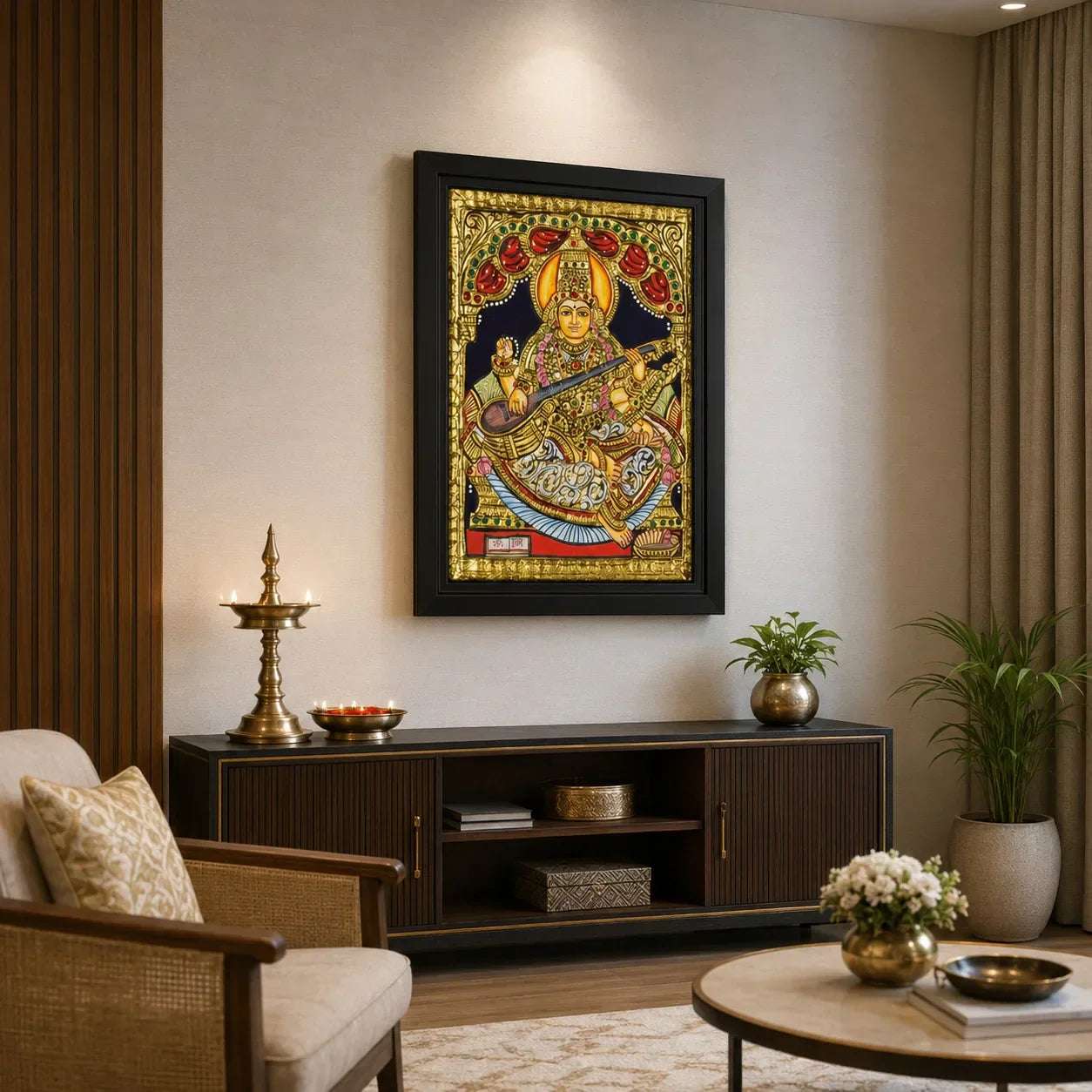
How to identify original Tanjore painting and understand why Tanjore paintings are costly is a major query for art collectors. Authentic pieces use 22-karat gold foil and semi-precious stones, which justifies their premium value.
Test 1: The Gold Doesn't Just Shine — It Behaves Differently Over Time
Real Thanjavur work uses 22-karat gold foil, hand-pressed onto the muck relief. Two things distinguish it from fakes, and only one of them you can check instantly.
Instantly: Tilt the painting at a low angle under a warm bulb, not fluorescent light. Real gold foil gives a soft, slightly matte-warm glow that shifts gently as you move — it doesn't throw a hard reflective glare. Imitation gold leaf (usually brass, aluminum, or metallic gold paint) throws a sharper, almost plasticky flash, especially under white LED light.
Over time (the test sellers hope you never run): Genuine 22k gold foil is chemically inert. It will look identical in 20 years. Imitation gold reacts with air and humidity — ask any seller directly, "do you have a photo of this exact piece from a year or more ago?" A seller confident in real gold will have this. A seller using imitation foil usually won't, because the piece has already started dulling or greening at the edges in storage.
Test 2: Muck Work Should Feel Like Sculpture, Not Like a Sticker
The embossed crowns, arches, and jewelry are built from a chalk-powder and gum-paste mixture, applied by hand and left to cure before gold foil goes on.
Run a fingertip — lightly — across a raised border. Real muck work has depth you can feel change under your finger: thicker at the center of a motif, tapering at the edges, with small asymmetries between one flower and the next because no two were pressed identically.
Machine-molded or puff-paint fakes are suspiciously symmetrical. If you zoom into a listing photo and every repeating motif on the border is pixel-identical, that's not a compliment to the artist — it's a print run.
Test 3: Stones Are Embedded, Not Glued On Top
This is the fastest test if you have the piece in hand, and the easiest one to fake convincingly in photos.
Real stones — Jaipur-cut semi-precious stones or genuine cut glass — are pressed into the wet muck paste before it cures, so they sit slightly recessed, locked in on all sides. Look at the edge where stone meets gold: there should be no visible glue line.
Fakes glue flat-backed rhinestones onto an already-finished print. You'll see a thin ring of adhesive residue around each stone if you look closely, and if you press one gently with a fingernail, it can pop loose. A seller who tells you "don't touch the stones" during an in-person viewing is a red flag worth listening to.
Test 4: Flip It Over — the Back Tells You More Than the Front
This is the test almost nobody asks for, and the one that's hardest to fake economically.
An authentic piece sits on a solid plywood or wooden board, wrapped in cloth conditioned traditionally with tamarind paste, then set into a genuine teak or rosewood frame. Lift it: it should have real weight and rigidity, no flex when you press the center of the back panel.
Mass-produced pieces cut costs here first, because the back is invisible in a listing photo. MDF board, foam core, or thin plywood flexes under light pressure and feels noticeably light for its size. If a seller won't send you a photo or video of the back and frame joinery before you pay, that omission is the answer.
Test 5: The Face Under Magnification Is the Final Word
Zoom into the deity's face — eyes, eyebrows, the curve of the lips — with a phone camera at maximum digital zoom, or a jeweler's loupe if you're viewing in person.
Hand-painted gouache or mineral-pigment work shows brushstroke variation: lines that thicken and thin slightly, small human imperfection in symmetry. A digitally printed face, even a good one, resolves into a grid of CMYK dots once you're zoomed in close enough, with a flat sheen from the varnish sitting on top of a printed surface rather than layered paint.
This test alone has ended more disputes than the other four combined, because it's nearly impossible to fake convincingly at high zoom.
Real vs Fake: The Five Tests at a Glance
| Test |
Authentic Tanjore |
Fake / Imitation |
| Gold |
22k foil, warm matte glow, ages unchanged |
Metallic paint or brass leaf, harsh glare, greens/dulls within months |
| Relief (Muck Work) |
Hand-built, slight asymmetry, real depth under touch |
Machine-molded or puff paint, perfectly uniform, flat edges |
| Stones |
Jaipur semi-precious, embedded in wet paste, no glue line |
Glued rhinestones/acrylic, visible adhesive, can pop off |
| Board & Frame |
Solid wood, tamarind-cloth base, real teak/rosewood frame |
MDF, foam core, or synthetic frame — feels light and flexes |
| Face detail |
Hand brushstrokes, minor line variation |
CMYK dot pattern visible under magnification |
Five Questions to Ask a Seller Before You Pay
If you're buying online and can't run these tests yourself, these five questions do most of the work for you:
- "Can you send a close-up video of the back of the board and the frame joints?"
- "Is the gold 22-karat foil, and can I see a certificate or sourcing note for it?"
- "Are the stones semi-precious or synthetic, and are they set in the muck layer or applied after?"
- "Which artisan cluster or workshop made this piece?"
- "Do you have a zoomed, high-resolution photo of the deity's face?"
A seller who answers all five without hesitation is usually selling the real thing. A seller who deflects even one — especially the board question — is worth a second thought before you commit.
Why This Still Matters Even If You're Not an Expert
You don't need to become an art appraiser to buy well. You need to know that a 15x12 inch original piece represents 2–4 weeks of an artisan's hand work, real 22-karat gold, and genuine stone — and that the price difference between that and a printed imitation isn't really about "expensive vs cheap." It's about whether you're buying heritage craftsmanship or a decorated print.
At Avyaan, every Tanjore piece we list is checked against exactly these five tests before it's photographed for sale — gold purity, muck relief by hand, embedded Jaipur stones, solid teakwood framing, and hand-painted detailing. If you want to see what a piece that passes all five looks like, our Tanjore Paintings collection is a reasonable place to start comparing.
Frequently Asked Questions (FAQs) – Tanjore Painting Buying Guide
Q1. How can I tell if a Tanjore painting is made of real gold?
Ans: Real Tanjore paintings use authentic 22-karat gold foil. When you view the painting from different angles under natural light, it emits a rich, warm, and radiant golden glow. Fake paintings use cheap imitation metallic paint or brass leaf, which gives a harsh, mirror-like artificial glare and turns blackish-green within a few months due to oxidation.
Q2. Why are original Tanjore paintings so expensive?
Ans: An original Tanjore painting is a highly labor-intensive luxury art form. It involves premium, costly raw materials such as pure 22k gold foil sheets, authentic semi-precious Jaipur gemstones, and heavy seasoned teakwood frames. Furthermore, a single painting takes anywhere from 15 to 30 days of meticulous manual embossing and artwork by skilled traditional artisans.
Q3. Do authentic Tanjore paintings lose their color or shine over time?
Ans: No. Because genuine Tanjore paintings use pure, unrefined 22-karat gold foil, the gold relief work will never rust, fade, or lose its luster for decades. The mineral and gouache colors used for the deities are well-preserved under protective glass framing, making these paintings valuable family heirlooms.
Q4. What is the 3D work on Tanjore paintings called?
Ans: The distinct 3D raised embossing or relief work seen on the crowns, jewelry, and pillars of a Tanjore painting is called 'Muck Work'. It is traditionally crafted by hand using a thick paste made of pure chalk powder and unrefined Arabic gum.
Q5. How can I spot a digitally printed fake Tanjore painting?
Ans: Take a close look at the faces of the deities or smooth backdrops under a magnifying glass. A fake or printed copy will show microscopic patterns of cyan, magenta, and yellow digital printing dots. An original painting will always show organic, continuous matte brushstrokes and slight handcrafted variations in line thickness.


![[Product Title] - Avyaan](http://aavyaan.com/cdn/shop/files/Grace_of_Beginnings_Ganesha_in_Tanjore_Gold_800x800_5057dc37-751a-4085-b2c1-a1a947001f54.webp?v=1784792848&width={width})
![[Product Title] - Avyaan](http://aavyaan.com/cdn/shop/files/Mockup_Ganga_Avataran_1.png?v=1784793858&width={width})
![[Product Title] - Avyaan](http://aavyaan.com/cdn/shop/files/26.png?v=1784792915&width={width})
![[Product Title] - Avyaan](http://aavyaan.com/cdn/shop/files/Tanjore-radhakrishna-png_1.webp?v=1784792858&width={width})
![[Product Title] - Avyaan](http://aavyaan.com/cdn/shop/files/Mockup_3.2_1-1.png?v=1784794004&width={width})
![[Product Title] - Avyaan](http://aavyaan.com/cdn/shop/files/Radiance_of_Prosperity_Gaja_Lakshmi_in_Tanjore_Splendor_2.webp?v=1784792826&width={width})
![[Product Title] - Avyaan](http://aavyaan.com/cdn/shop/files/29.png?v=1784792820&width={width})