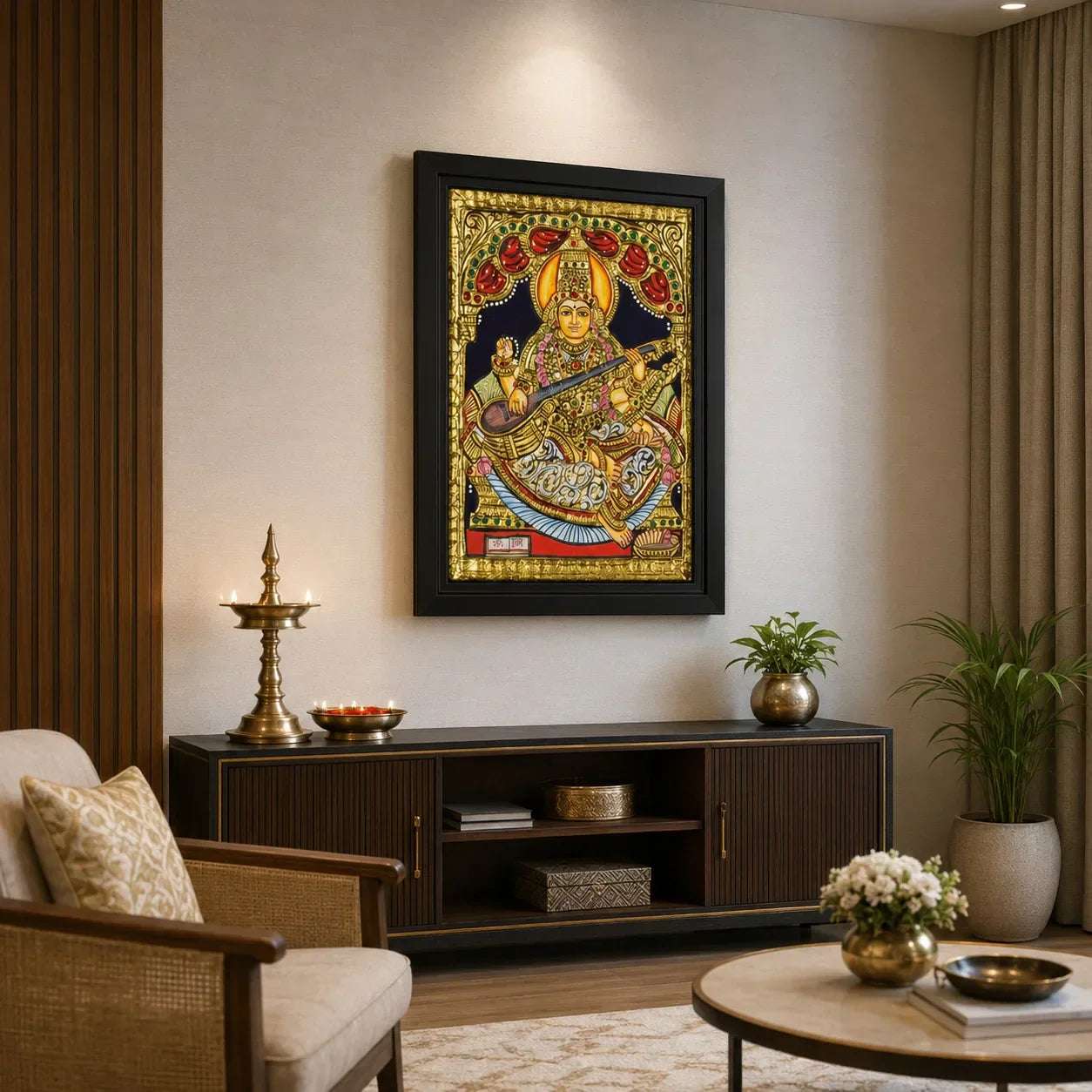
Whether you are buying from a local gallery in Tamil Nadu or shopping online, fake imitations can easily deceive an untrained eye. To protect your investment, here is our comprehensive 7-point checklist to verify the authenticity of a Tanjore painting before bringing it into your home altar.
🛡️ Quick Summary: The Golden Rule of Authenticity
Real Tanjore art uses heavy seasoned wood and 22k gold leaf sheets that never lose their tarnish. If the painting feels lightweight, looks overly glittery, or lacks dimensional texture, it is likely a digital print or a synthetic counterfeit.
1. The Gold Foil Metallic Luster
Authentic traditional panel paintings rely strictly on 22-karat pure gold leaf sheets. Genuine gold exhibits a distinct, rich, and warm warm-yellow metallic glow. Counterfeit options swap this out for synthetic aluminum foils or copper foil papers chemically treated with gold coloring. Synthetic gold looks excessively bright, harsh, and flashy when caught under direct light, and will inevitably turn tarnish-black or greenish within 2 to 3 years due to oxidation.
2. Tactile Texture of the Gesso Relief
Every genuine masterpiece is built using a limestone paste mock-work that creates a prominent three-dimensional relief layer beneath the gold. When you gently run your fingers over the arches, pillars, or crowns of the deities, you should distinctly feel a raised tactile texture. Fake replicas are often entirely flat digital prints where the 3D depth is merely an optical illusion on paper.
3. The Reflection and Cuts of Gemstones
Traditional heritage workshops insert hand-cut semi-precious Jaipur gems or classical glass beads into the relief paste. These stones have minor organic variations in shapes and facets. Cheap commercial variants replace these with uniform plastic rhinestones, molded resins, or industrial acrylic beads that have completely flat machine-cut surfaces and a distinct artificial shine.
4. Material Weight of the Base Plank
A true master painting is crafted over a seasoned teak or jackfruit wood board wrapped in unbleached cotton fabric. These materials make the finalized panel structurally heavy and rigid. Counterfeit variants use lightweight, modern MDF (Medium-Density Fiberboard), cheap plywood templates, or even standard cardboard bases that warp easily when exposed to changing humidity.
5. The Expression in the Eyes of Deities
The hallmark of a high-quality handmade Tanjore painting lies in the facial expressions, particularly the eyes. Master artisans spend hours perfecting the serene, almond-shaped eyes of Lord Krishna or Goddess Lakshmi to ensure they evoke a sense of peaceful meditation. In mass-printed or amateur replicas, the facial features often look asymmetrical, rigid, or entirely devoid of spiritual emotion.
6. Natural Mineral and Watercolor Bleeds
While the background and jewelry glow with gold, the deity’s skin and attire are filled with paints. Authentic works utilize premium poster colors or traditional mineral pigments applied with fine brushes, showing subtle brush strokes and organic shade transitions under close inspection. Digital canvas prints coated with plastic layers show absolutely flawless color blocks without any humane brush textures.
7. Gallery Transparency and Artist Credentials
A major indicator of Tanjore painting authenticity is the provider’s transparency. Reputable galleries always document the creation process, name the traditional artisans involved, and gladly explain the weight and karats of the precious metals used. Avoid vendors who refuse to disclose material details or offer massive, unrealistic discounts on large-sized panels.
Frequently Asked Questions
Q1: Does a real gold Tanjore painting come with a certificate?
While there is no single centralized government board, established heritage organizations and transparent galleries provide their own signed certificates of authenticity, verifying the 22k gold leaf purity and handmade wooden framework.
Q2: Will a real gold leaf Tanjore painting tarnish over time?
No. Authentic 22-karat gold leaf foil does not oxidize, fade, or tarnish. Even after decades or centuries, the gold elements will maintain their original royal metallic sheen, provided the painting is kept away from moisture.
Q3: How can I safely test the gold leaf at home?
The safest way is the visual inspection and aging test. Fake foils turn dark greenish-black within a few years due to air exposure. Real gold will stay perfectly untarnished. Avoid scraping or chemical testing as it can damage the delicate relief work.


![[Product Title] - Avyaan](http://aavyaan.com/cdn/shop/files/Grace_of_Beginnings_Ganesha_in_Tanjore_Gold_800x800_5057dc37-751a-4085-b2c1-a1a947001f54.webp?v=1784792848&width={width})
![[Product Title] - Avyaan](http://aavyaan.com/cdn/shop/files/Mockup_Ganga_Avataran_1.png?v=1784793858&width={width})
![[Product Title] - Avyaan](http://aavyaan.com/cdn/shop/files/26.png?v=1784792915&width={width})
![[Product Title] - Avyaan](http://aavyaan.com/cdn/shop/files/Tanjore-radhakrishna-png_1.webp?v=1784792858&width={width})
![[Product Title] - Avyaan](http://aavyaan.com/cdn/shop/files/Mockup_3.2_1-1.png?v=1784794004&width={width})
![[Product Title] - Avyaan](http://aavyaan.com/cdn/shop/files/Radiance_of_Prosperity_Gaja_Lakshmi_in_Tanjore_Splendor_2.webp?v=1784792826&width={width})
![[Product Title] - Avyaan](http://aavyaan.com/cdn/shop/files/29.png?v=1784792820&width={width})