Cart
0
You may also like





By Avyaan | Art & Culture | 7 min read

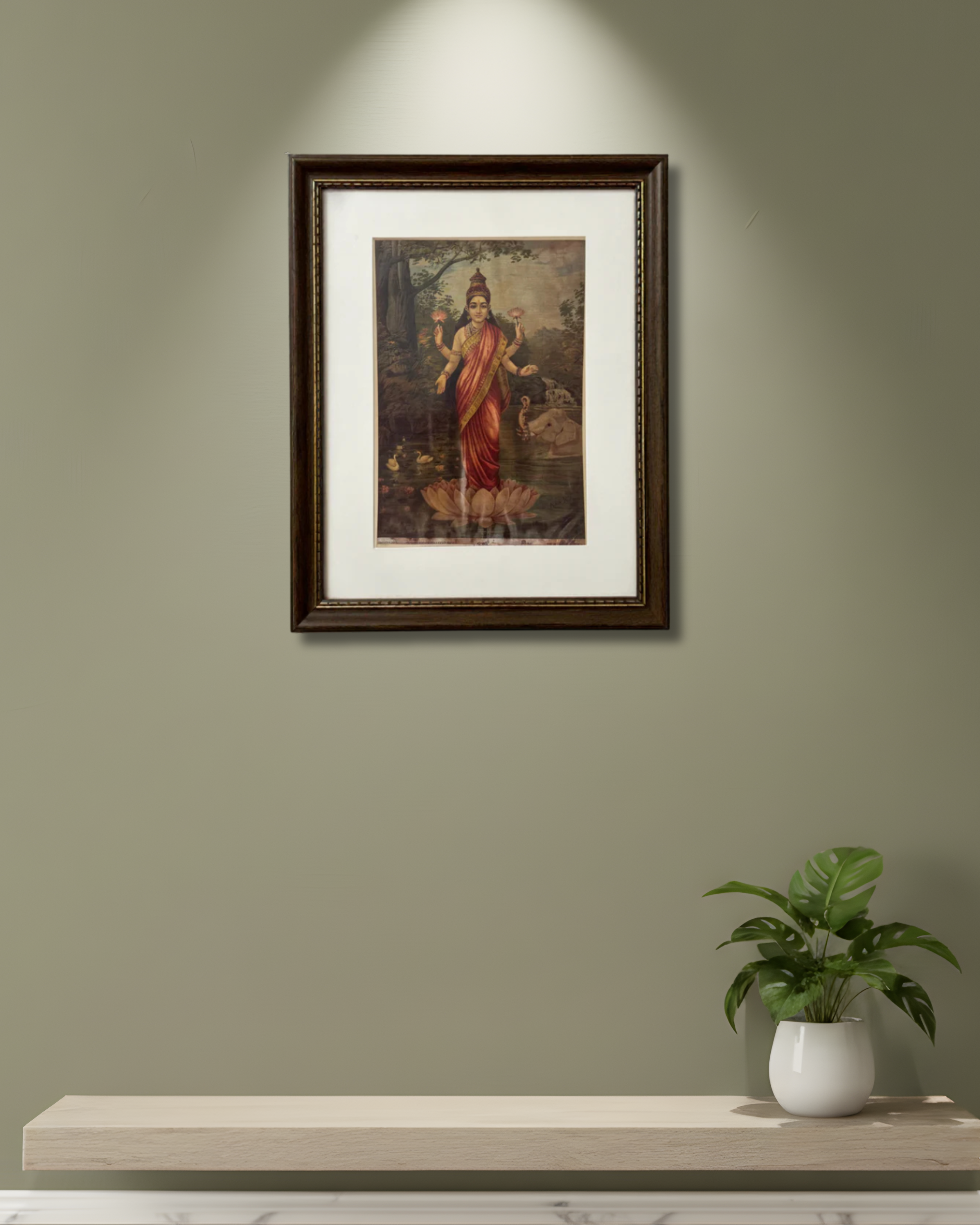
It is difficult to overstate the degree to which Ravi Varma's women have shaped the Indian visual imagination. His depictions of Hindu goddesses and mythological heroines — Lakshmi, Saraswati, Damayanti, Shakuntala, Radha — entered Indian popular culture in the 1890s and have never left it. If you close your eyes and picture the Hindu goddess of wealth, the image that comes to mind is almost certainly shaped, directly or indirectly, by Ravi Varma's Lakshmi.
This guide introduces his most significant female subjects — who they are, how he depicted them, and what makes each image remarkable.
Ravi Varma's Lakshmi — typically shown standing on a lotus, gold coins pouring from one hand, the other raised in the gesture of blessing, draped in red silk and heavy gold jewelry — became the defining image of the goddess of wealth for the 20th century.
What makes his Lakshmi so effective is its synthesis: the face has a quality of specific, individual personhood (based, some historians believe, on South Indian women from Ravi Varma's own social circle) that makes the goddess feel present rather than abstract. The jewelry is accurately rendered — identifiable as South Indian in type, but magnificent enough to suggest divinity. The lotus and the gold maintain the iconographic requirements of the tradition while being rendered with European academic realism.

Ravi Varma's Saraswati — seated on a white lotus, holding her veena, with a swan nearby — is the image of the goddess of knowledge and music that appears in schools, colleges, music institutions, and cultural organisations across India. He painted her multiple times, in different compositions, with slightly different placements of her attributes.
The most famous version shows her in white garments, with books, a veena, and a rosary — the complete set of her iconographic attributes — arranged with the compositional skill of a European academic painter. The result is a goddess who is simultaneously majestic and approachable.
From the mythological realm of human women, Shakuntala — the heroine of Kalidasa's 5th-century Sanskrit play Abhijnanasakuntalam — is perhaps Ravi Varma's most beloved subject. He painted her multiple times, always in the forest setting of her hermitage, absorbed in writing a letter to her beloved King Dushyanta.
The image of Shakuntala writing the letter — bent slightly over her palm leaf, her expression one of concentrated longing — is one of the most emotionally direct of all Ravi Varma's works. The painting was shown at the Vienna World Exhibition in 1873, where it won a first-class gold medal.

Damayanti, the princess who chose the mortal king Nala over the gods who courted her, is one of the great love stories of the Mahabharata. Ravi Varma's most celebrated painting of Damayanti shows her in conversation with a swan — the bird that carried messages between her and Nala.
The "Damayanti Talking to a Swan" is one of the highest achievements of Indian 19th-century painting. The figure's pose — slightly forward, intent on the swan, one hand raised in emphasis — communicates both the longing and the agency of the character.
Radha — the great devotee of Krishna, whose love is the paradigm of bhakti in the Vaishnava tradition — appears in Ravi Varma's work in multiple contexts: at the riverside, in the forest, waiting for Krishna, meeting with Krishna.
Ravi Varma's Radha is one of the few subjects where his European academic training and the specifically Indian emotional content of the image are in perfect balance. The face of waiting — that particular quality of longing, of suspended expectation — is one of the most universal human experiences, and Ravi Varma captured it with extraordinary precision.
Discover authentic Ravi Varma oleographs at https://aavyaan.com/
Loading Mark360 Popup...

